How to Pass a California Smog Check (and Why Cars Fail)
Sunday, January 18, 2026 · Updated · Fact-checked against official sources

To pass a California smog check, fix any check engine light first, let the car's readiness monitors finish after a repair or battery change, and make sure no emissions parts are missing or modified. Those cover most failures: in BAR's August 2026 report, 7.60% of on-board computer tests failed, and 6.63% failed on OBD-II problems.
Most of the result is decided before you pull into the station. Here is why cars fail, and the order of preparation that actually changes the outcome.
Why do cars fail a California smog check?
Cars fail a California smog check mostly because of the on-board diagnostic (OBD-II) system: a lit check engine light, stored trouble codes or incomplete readiness monitors. In BAR's August 2026 report, 6.63% of on-board computer (OIS) initial tests failed the OBD-II check, including 3.93% for readiness alone. Visual failures were 1.34%.
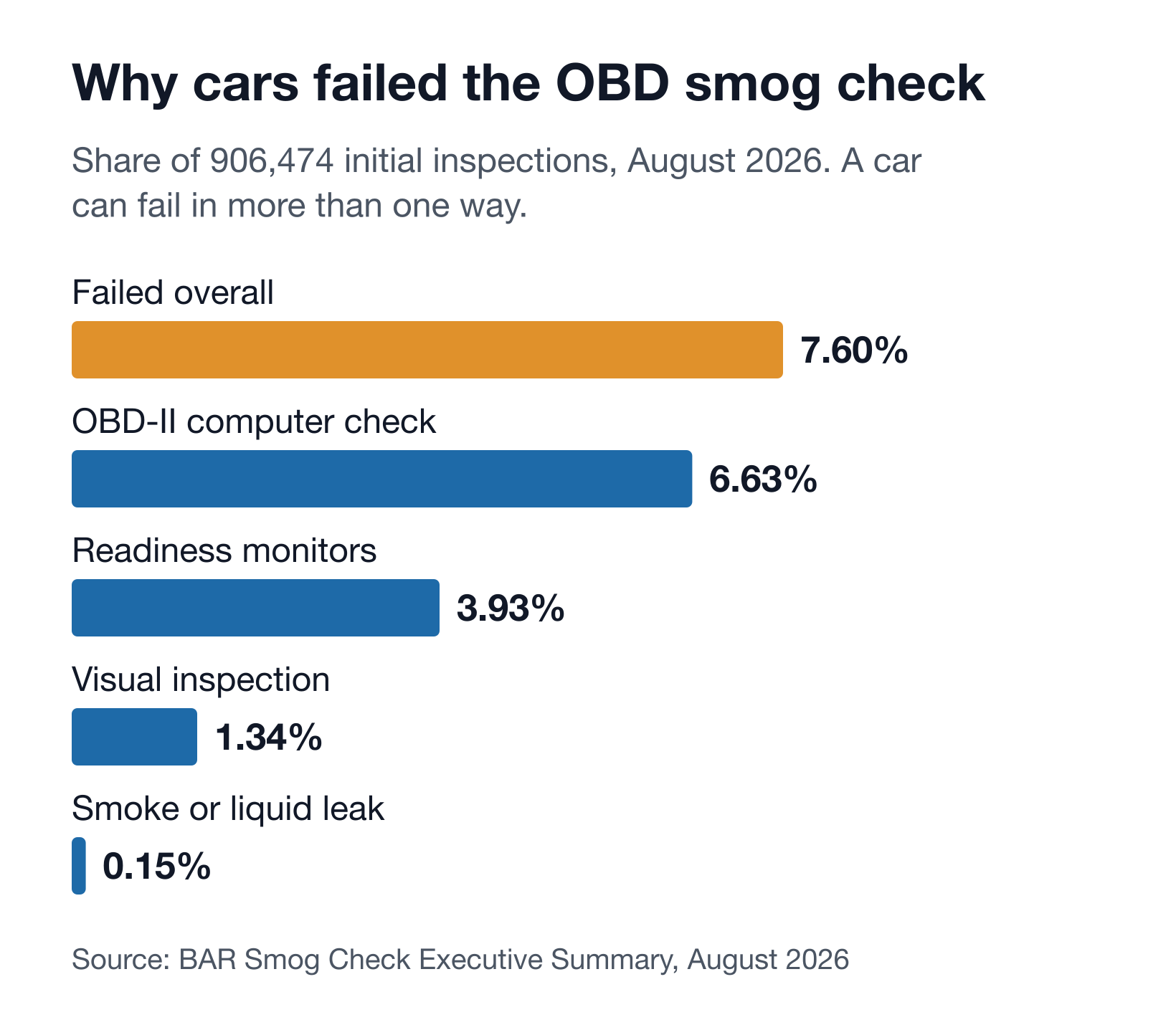
The categories overlap, because one car can fail several ways at once. Out of 906,474 OIS initial tests, 68,905 failed.
Older cars on the BAR-97 tailpipe test fail far more often: 17.81% of 62,489 initial tests. Of those tests, 10.45% failed on tailpipe emissions, 8.40% on functional checks, 3.20% on the visual inspection and 2.53% as gross polluters.
The Smog Check Referee lists the same culprits in plain terms: excessive tailpipe emissions, non-approved parts or computer programming, check engine light or monitor failures, faulty sensors or computer controls, and vacuum leaks.
Does the age of your car affect whether it passes smog?
The age of your car strongly affects whether it passes a California smog check. In BAR's August 2026 data, 2000 model year cars failed their on-board computer test 15.30% of the time, 2010 models 7.62%, 2018 models 4.23% and 2025 models 3.53%. Readiness failures follow the same curve, from 10.01% for 2000 models to 2.06% for 2018.
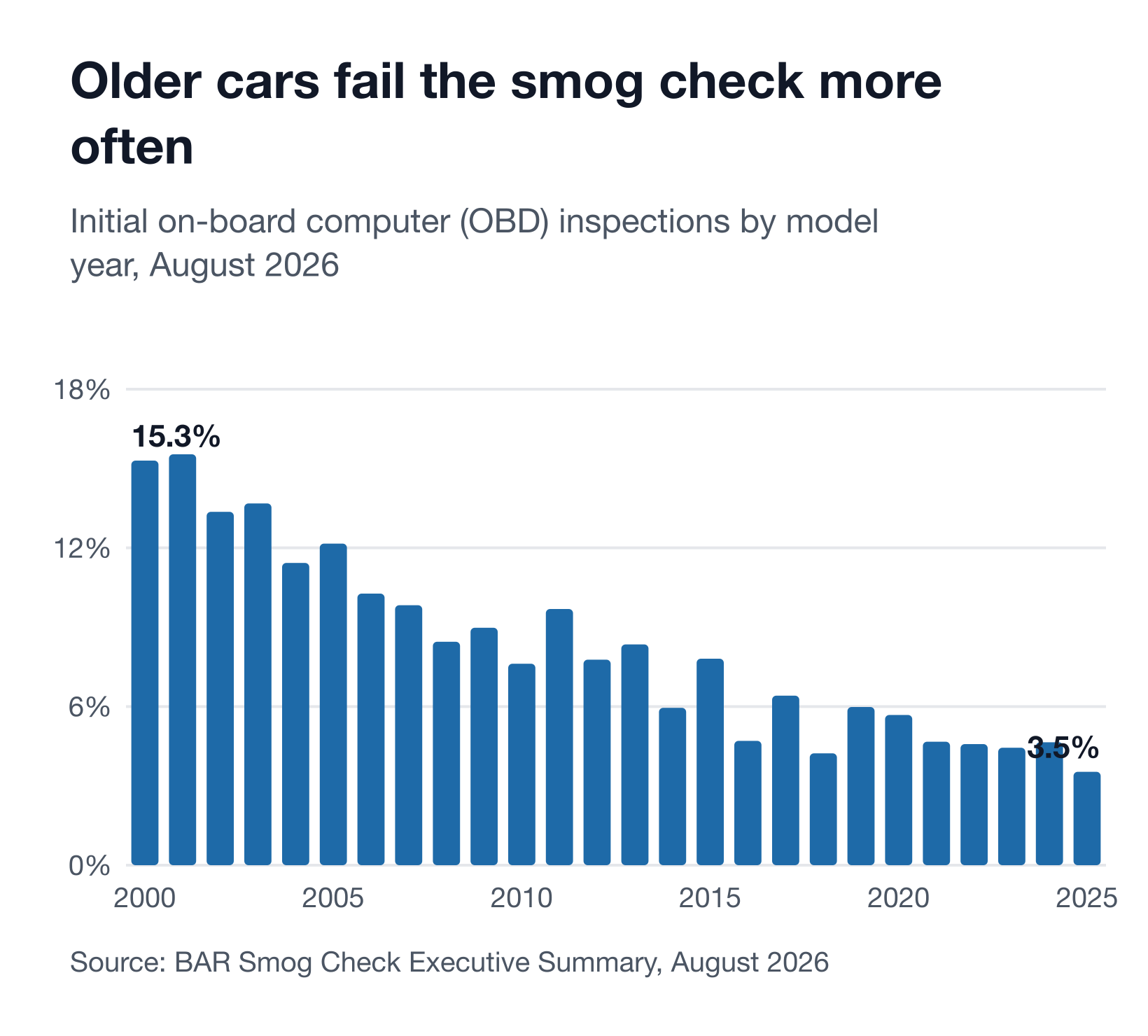
The decline is not perfectly smooth. Model years with fewer tests that month sometimes run higher than their neighbors: 2015 models failed 7.81%, for example. The trend is still clear. If your car is approaching 20 years old, budget time for the preparation below.
What are the most common reasons a car fails smog?
The most common reasons a car fails a California smog check are a lit check engine light with stored codes, readiness monitors that have not finished, missing or non-approved emissions parts, and high tailpipe readings on 1999 and older cars. Smoke and fuel leaks are rare, at 0.15% of OIS initial tests in August 2026.
Check engine light and trouble codes
A check engine light that stays on with the engine running is an automatic fail. So is a light that never comes on at all when you turn the key to "on" without starting, because the inspector has to see the bulb work. Our check engine light guide covers both.
Incomplete readiness monitors
Readiness monitors are self-tests the engine computer runs while you drive. Clearing codes or disconnecting the battery resets them, and a car with too many unfinished monitors fails even with a dark dashboard.
Missing, modified or non-approved parts
The visual inspection fails anything missing, modified or disconnected. Since January 1, 2009, aftermarket catalytic converters installed in California must carry a CARB Executive Order number and be approved for your exact vehicle. Modified engine software fails too, unless it is restored to factory or a CARB-approved version.
High tailpipe emissions on older cars
1999 and older cars are measured at the tailpipe. Unburned fuel from misfires, a rich mixture from a failing sensor, and a worn catalytic converter are the usual sources. A converter often fails because something upstream, like a misfire, has been feeding it raw fuel, so a good shop checks the cause before selling you the part.
Gas cap and fuel system on 1976 to 1995 cars
1976 to 1995 cars get a fuel cap integrity test. A cap with a damaged seal or the wrong fit fails, and the station can replace it mid-inspection.
How should you prepare for a smog check?
Prepare for a California smog check about two weeks ahead. Check that the check engine light comes on with the key and goes off once the engine starts, get any stored fault repaired, then drive normally so the readiness monitors finish. BAR advises driving a week or two after a battery disconnect or replacement before testing.
A simple timeline:
- Two weeks out: turn the key to "on" and watch the dashboard. If the check engine light stays on after the engine starts, book a repair, not a smog check.
- After any repair or new battery: drive normally for a week or two, mixing short trips and longer drives. A scan tool can show monitor status before you pay for a test.
- The week before: catch up on routine maintenance. The Referee's own advice is that oil changes and regular servicing raise the odds of passing.
- If the software was modified: restore it to the factory or a CARB-approved version.
Skip products sold as a smog-test fix. A pour-in additive does not erase a stored trouble code, finish a readiness monitor or replace a missing part.
How many incomplete monitors are allowed?
These are the pass limits on the Smog Check Referee's monitor readiness page. BAR adopted a stricter rule effective October 1, 2025, requiring every monitor that can feasibly be set. It said these limits stay in place while it collects data, and it will phase in changes with advance notice.
| Vehicle | Incomplete monitors allowed |
|---|---|
| 1996 to 1999 gasoline | Any one |
| 2000 and newer gasoline | Evaporative system only |
| 1998 to 2006 diesel | None |
| 2007 and newer diesel | Particulate filter and NMHC catalyst only |
Should you clear the check engine light before a smog check?
You should not clear the check engine light before a California smog check. Erasing the codes with a scan tool turns the light off but leaves the fault in place, and it resets the readiness monitors to "not ready." The car then fails for incomplete monitors instead, and the next technician has lost the codes that pointed to the problem.
The Referee notes that some cars will not finish their monitors even after hundreds of miles until the underlying fault is properly diagnosed and repaired. If a shop keeps telling you to "drive it more," a second opinion from another repair shop is reasonable.
Is a smog check pre-inspection worth it?
A smog check pre-inspection can be worth it for an older or borderline car. Some California stations offer a pretest that runs the same procedure without issuing a certificate, and BAR requires an estimate first. A pre-inspection is also exempt from the gross polluter requirements, so a bad result does not restrict where the car can be certified.
Pre-inspection results are still sent to BAR's database, and you get a copy of the report. A test-and-repair station can use it to confirm a repair before the official test.
What should you bring and check on test day?
Bring your DMV registration renewal notice to the smog check. It helps the station confirm your vehicle, and it tells you whether the car must be tested at a STAR station. If the notice says "Smog Certification Required at a STAR station," only a STAR station can certify it. Otherwise, any licensed station works.
Arrive with the engine warm. Inspectors bring the engine to normal operating temperature before a tailpipe test anyway, but a cold engine just adds time. For what the inspector actually checks, see what happens during a smog check.
Before you hand over the keys, ask for the out-the-door price and the retest policy. There is no state-mandated free retest. Our smog check cost guide has BAR's average prices, the California smog check price report has coupon prices by county, and the smog check coupons page lists current discounts. If the notice says STAR, our STAR smog check guide explains why.
What should you do if your car fails anyway?
If your car fails a California smog check, read the vehicle inspection report before you leave, keep the trouble codes stored, and get the car diagnosed at a licensed test-and-repair or repair-only station. Income-eligible owners can get up to $1,450 toward repairs on 1996 and newer vehicles through the Consumer Assistance Program.
The full sequence, including warranty coverage, the $650 repair cost waiver and retirement payments, is in what to do after a failed smog check. The Consumer Assistance Program guide covers eligibility. When the car passes, the certificate goes to DMV electronically and is valid for 90 days. You can confirm it on our smog check history lookup, then find a station for any retest on the smog check near me page.
Sources: BAR Smog Check Executive Summary, August 2026 · BAR: Smog Check · BAR: New OBD readiness monitor regulations · Smog Check Referee: OBDII monitor readiness concerns · Smog Check Referee: Smog check results review · BAR Smog Check Manual
Figures checked against BAR, DMV and CARB sources as of October 2026.