What Happens During a California Smog Check
Wednesday, October 7, 2026 · Fact-checked against official sources

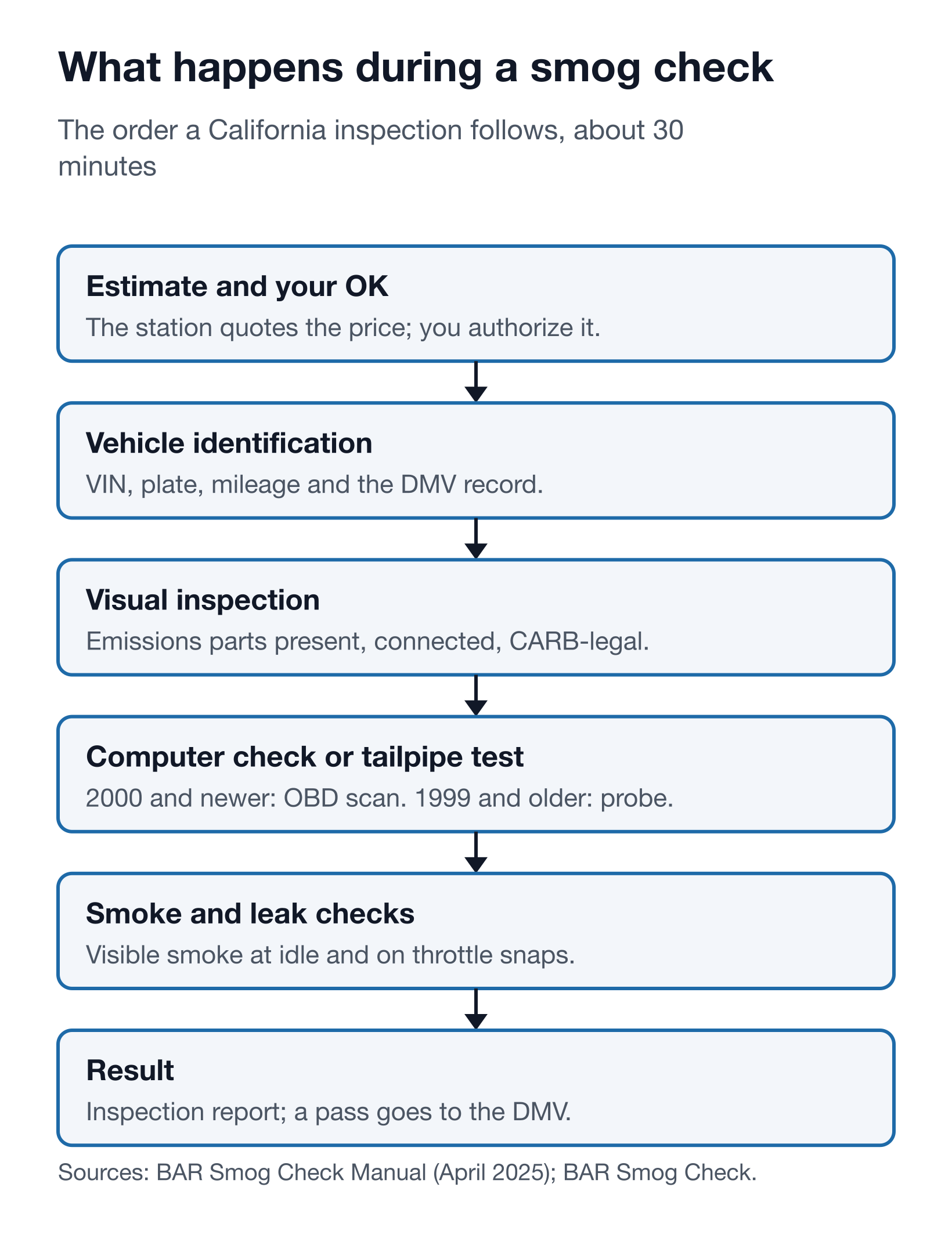
A California smog check takes about 30 minutes and follows procedures set by the Bureau of Automotive Repair (BAR): a written estimate, vehicle identification, then the inspection itself (a visual check, functional checks, an on-board computer (OBD) scan or tailpipe test, and a smoke test), and the result. As of October 2026, about 94% of initial tests are the computer check.
Below we follow each step as the inspector does, using BAR's Smog Check Manual (April 2025). For timing and how long a certificate lasts, see how long a smog check takes.
What happens first when you arrive for a smog check?
A California smog check starts with paperwork, not the car. The station must work out which test your vehicle needs, write an estimate, and get your authorization before the inspection begins. BAR's manual tells inspectors to determine the test type first, because the price often depends on it.
A few things can happen at the counter:
- The station turns the car away. A station that lacks the equipment, tools or reference material for your vehicle must reject it before starting.
- The station checks for a STAR direction. If your renewal notice says "Smog Certification Required at a STAR station," a non-STAR station must tell you it can't certify the car, and its equipment will block the test. See our STAR certified smog check guide.
- You're offered a pretest. A pre-inspection is identical to the official test, but issues no certificate and can't flag a gross polluter. It needs its own estimate.
Bring your DMV renewal notice, and show any smog check coupon before the estimate is written.
How does the inspector identify your vehicle?
The smog check inspector logs in with a license number and biometric scan, then scans the barcode on your registration or vehicle to enter the VIN, plate and odometer reading. The remaining vehicle details usually fill in automatically from BAR's Vehicle Information Database (VID).
The inspector confirms the VIN on the paperwork matches the car. If it doesn't, the VIN on the vehicle is used and you're warned the DMV may reject the result. The vehicle data decides which test and emissions standards apply, and once a certificate is issued it can't be voided.
Kit cars, grey-market imports and cars with engine changes need a BAR Referee label before a regular station can test them. Without one, you go to the Smog Check Referee first.
Which smog test does my car get?
The smog test your car gets depends on its model year, fuel type and where it's registered. Most 2000-and-newer gasoline and hybrid vehicles and 1998-and-newer diesels go on the OBD Inspection System (BAR-OIS), which reads the car's computer. Gasoline vehicles from 1976 to 1999 get the BAR-97 tailpipe test.
| Vehicle | Test system | Tailpipe test? |
|---|---|---|
| Gasoline, 1976–1995 | BAR-97 | Yes, plus fuel cap and evap pressure tests |
| Gasoline, 1996–1999 | BAR-97 | Yes, plus an OBD check |
| Gasoline, 2000 and newer | BAR-OIS | No |
| Hybrid, 2000 and newer | BAR-OIS | No |
| Diesel, 1998 and newer | BAR-OIS | No |
Some 2000-and-newer gasoline vehicles still get the BAR-97: those without OBD II, those over 14,000 lb gross vehicle weight rating (GVWR), and models BAR has flagged for problematic OBD systems.
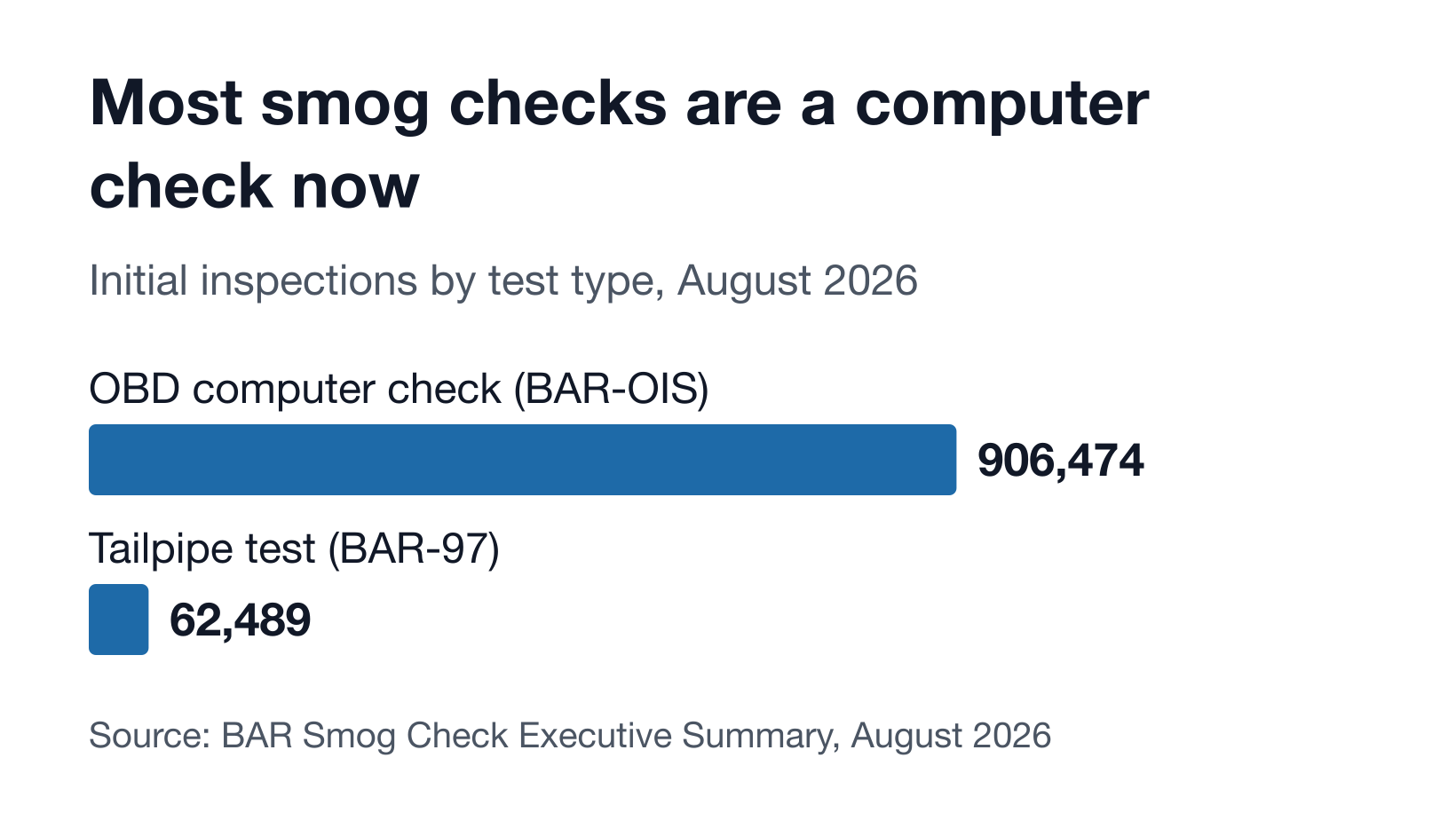
In BAR's August 2026 Smog Check Executive Summary, stations ran 906,474 initial OIS tests and 62,489 initial BAR-97 tests, so about 94% of initial inspections were the plug-in test.
What does the visual inspection check?
The smog check visual inspection confirms every required emissions part is present, connected and either factory-original or approved by the California Air Resources Board (CARB). The inspector compares what's under the hood with the underhood emissions label, BAR's application guides and CARB's approved parts lists. A missing or modified part fails the car.
Depending on the vehicle, the inspector looks at:
- Crankcase emission controls, such as the PCV valve
- Fuel evaporative (EVAP) system hoses and canister
- Catalytic converters and other exhaust after-treatment
- Exhaust gas recirculation (EGR)
- Ignition spark controls and fuel metering (injectors, throttle body, air flow meter)
- Air injection, on vehicles that have it
- Computers, sensors and switches, such as oxygen sensors
- "Other" emissions parts, including turbochargers, superchargers, intake and exhaust manifolds, and cylinder heads
Cars from 1976 to 1999 also get their thermostatic air cleaner checked.
What counts as a visual failure?
BAR fails a part as tampered when it is missing (removed), modified (disabled, or replaced with a part not sold for street use on that vehicle) or disconnected, and as defective when normal wear or an accidental disturbance stops it working. An aftermarket part that changes the emissions setup passes only if CARB has approved or exempted it, which the inspector checks by its Executive Order number.
The liquid fuel leak check
With the engine running, the inspector uses a flashlight and mirror to look for liquid fuel on visible parts: the tank, fuel lines, injectors, filter, gas cap, charcoal canister and vapor hoses. A visible drop or puddle fails the car, and a hazardous leak means the inspector refuses to test it. This check doesn't apply to diesel, CNG or propane vehicles.
What are the functional checks in a smog check?
Smog check functional checks test whether the emissions systems work, not just whether they're there. Every vehicle with a computer-controlled check engine light gets the light test. Most 1996-and-newer vehicles get an OBD II check of trouble codes and readiness monitors. Gasoline cars from 1976 to 1995 get extra hands-on tests instead: ignition timing, EGR, the fuel cap and an evaporative pressure test.
The check engine light test
The inspector turns the key to on with the engine off and watches the malfunction indicator light (MIL). It should light up, then go out once the engine starts. The car fails if the light never comes on at key-on, or if it stays on or flashes with the engine running. Maintenance reminders don't count. See check engine light and smog checks if yours is on.
The OBD test on 2000 and newer cars
For most cars this is the core of the inspection. The inspector plugs the OIS into the diagnostic connector under the dash. It checks that the computer communicates, reads trouble codes and the check engine light command, confirms the VIN, looks for software modifications, and checks readiness monitors, the self-tests the car runs as you drive. Under BAR rules in effect since October 1, 2025, all monitors that can feasibly be set must be complete, phased in by vehicle (BAR, Fall 2025).
That's why a car with a fresh battery or cleared codes fails. In August 2026, 3.93% of OIS initial tests failed on readiness.
Extra tests on 1976 to 1995 cars
- Ignition timing, on engines with adjustable timing, must be within 3 degrees of the manufacturer's spec.
- EGR function, on cars getting the two-speed idle test, follows the manufacturer's procedure.
- Fuel cap integrity has a visual part (threads, seal, correct cap) and a pressure test on an adapter. A failed cap can be replaced mid-inspection.
- The low pressure fuel evaporative test (LPFET) pressurizes the fuel tank side of the evap system to find vapor leaks.
How is the tailpipe test done on older cars?
The smog check tailpipe test on a 1976–1999 gasoline car measures exhaust gases with a probe in the tailpipe after the engine is fully warm and has idled for at least 3 minutes. Cars registered in Enhanced program areas run on a dynamometer (the ASM test); Basic and Change-of-Ownership areas use the two-speed idle (TSI) test instead.
ASM (Enhanced areas). The drive wheels sit on rollers so the car runs under load in place, through two phases called 50/15 and 25/25. The car is restrained, a cooling fan is positioned and the hood is lowered. All-wheel-drive cars, traction control that can't be disabled, and heavier trucks and motorhomes get the TSI test instead.
TSI (Basic and Change-of-Ownership areas). The car stays parked. The engine runs at 2,500 RPM for 30 seconds, then at idle. If it fails, the system prompts a conditioning step and a second-chance test.
Inspectors may not rev the engine to heat up the catalytic converter before the test. Who needs which inspection, and when, is in our smog check requirements guide.
What is the visible smoke test?
The visible smoke test is a short visual check for smoke from the tailpipe and the engine crankcase, done on gasoline and diesel vehicles but not hybrids. The inspector watches the exhaust at idle for 10 seconds, watches the crankcase for 10 seconds, then performs three quick "snap" throttle blips to between 2,000 and 3,000 RPM.
Smoke during the first snap doesn't count. Any smoke at idle or from the crankcase fails the car. On the final two snaps, a gasoline car fails for any visible smoke within 10 feet of the tailpipe. Diesels have their own standard, which we cover in the diesel smog check guide. Smoke from anywhere other than the tailpipe or crankcase doesn't count.
Only 0.15% of OIS initial tests in August 2026 failed on smoke or a fuel leak.
What happens at the end of a smog check?
At the end of a California smog check, the station prints a Vehicle Inspection Report (VIR) signed by the inspector, and you get a copy. The VIR shows the result, each part of the test, and any open safety recalls on your vehicle. A pass sends the certificate to the DMV electronically, valid for 90 days.
On a pass, the station charges the $8.25 state certificate fee. You can confirm the record the next day on BAR's smog check history lookup.
On a fail, the VIR names what failed. After repairs, most cars can retest at any test-only or test-and-repair station. A directed vehicle or a gross polluter can only be certified at a STAR station or the Referee. BAR's August 2026 report shows 7.60% of OIS initial tests failed, against 17.81% on the BAR-97. Read what to do after a failed smog check next.
Can the station fix things during the test?
Only small things. With your authorization, a technician can replace a fuel cap, reconnect a hose or vacuum line, or fix something the station damaged, before the emissions portion starts. Anything bigger is a repair job; see test-only vs test-and-repair stations.
When you're ready, find a station on our smog check near me page.
Sources: BAR Smog Check Inspection Procedures Manual, April 2025 · BAR: Smog Check · BAR Smog Check Executive Summary, August 2026 · BAR: OBD readiness monitor regulations (Fall 2025) · DMV: Smog inspections
Figures checked against BAR, DMV and CARB sources as of October 2026.