Failed Your Smog Check? What to Do Next in California
Thursday, June 11, 2026 · Updated · Fact-checked against official sources

If your car fails a California smog check, read the vehicle inspection report, have the car diagnosed and repaired at a licensed test-and-repair or repair-only station, then retest. You have company: 8.26% of initial inspections failed in BAR's August 2026 report. Income-eligible owners can get up to $1,450 toward repairs, and a repair cost waiver applies after $650 of repairs.
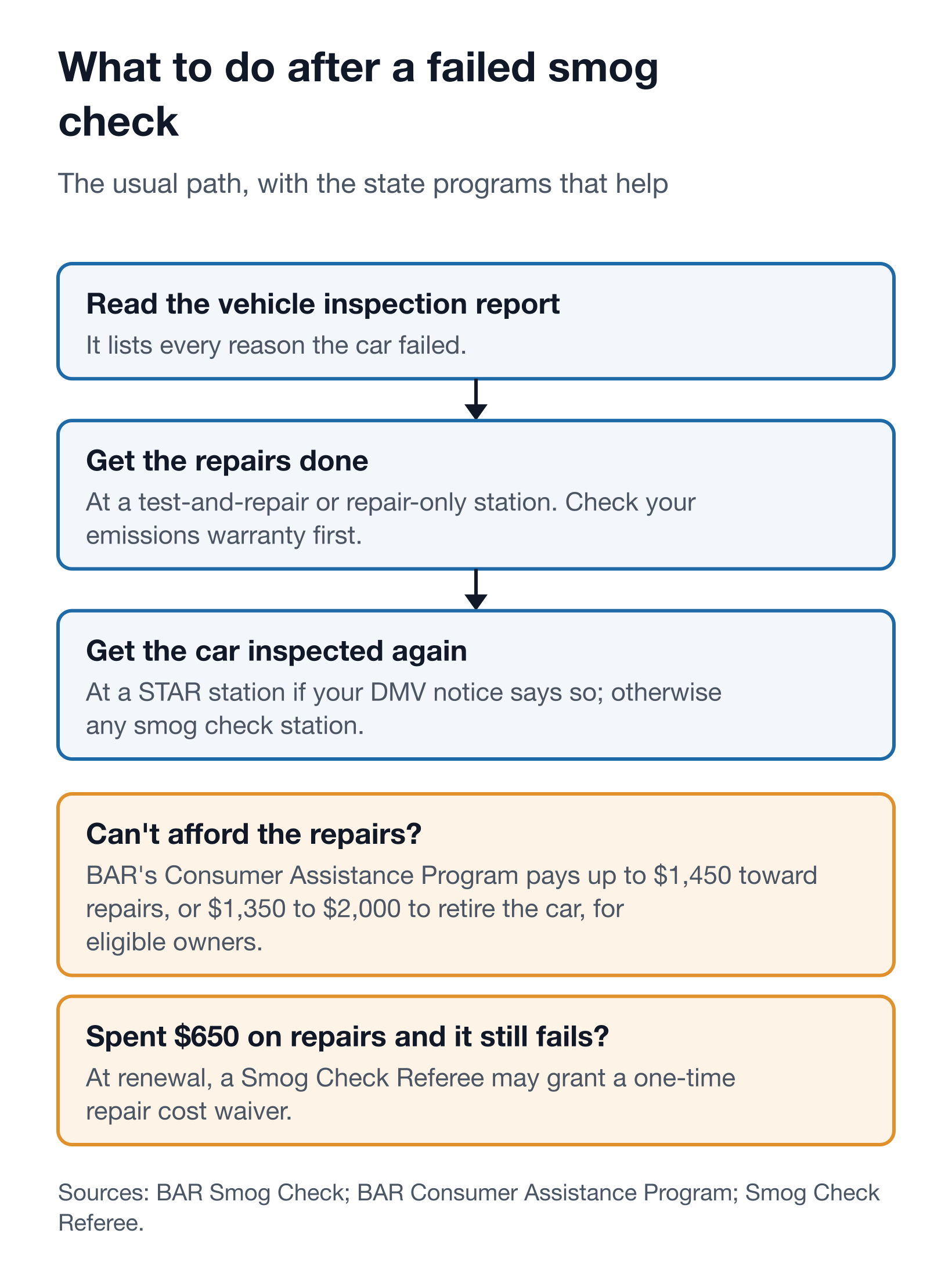
Do the steps in this order. Skipping the diagnosis to guess at parts is how a sensor problem turns into a catalytic converter bill.
What happens if you fail a smog check in California?
When a car fails a California smog check, the station issues no certificate, so the car cannot complete its registration renewal or change of ownership until it passes. The failure appears in BAR's public inspection history the next business day. You then repair the car and retest, at a STAR station if the DMV notice says so.
The failure does not pause your registration expiration date, so start the repair process right away. BAR's August 2026 report shows how failure rates split by test:
- 7.60% of on-board computer (OIS) tests failed, mostly 2000 and newer cars.
- 17.81% of BAR-97 tailpipe tests failed, mostly 1999 and older cars.
How do you read a failed vehicle inspection report?
A vehicle inspection report lists every part of the California smog check and marks each one pass or fail. Look for the failed category first: OBD-II faults and trouble codes, incomplete readiness monitors, the visual inspection, a functional test, or tailpipe emissions on an older car. Each points to a different kind of repair and cost.
What to look for on the report:
- Trouble codes: write them down and leave them stored in the car. Do not clear them, since that resets the readiness monitors and creates a second failure.
- Readiness monitors: a "not ready" result often follows a battery change or recent repair. Our check engine light guide explains drive cycles.
- Visual failures: a missing, modified or disconnected emissions part, including an aftermarket converter without a CARB Executive Order number.
- Gross polluter: emissions far above the normal limit. That restricts where the car can be certified, as explained in gross polluter: what it means.
The report also lists open safety recalls, so check that section too. For the most common causes behind each category, see how to pass a California smog check.
Where should you get the car repaired after a failed smog check?
After a failed California smog check, get the car repaired at a licensed test-and-repair station or a repair-only station. Test-only stations can inspect and certify, but cannot diagnose or repair, and they may not refer you to a particular repair shop. You can repair at a different shop from the one that ran the failed test.
Check warranty coverage before paying for anything. California-certified cars must be warranted to pass smog for 3 years or 50,000 miles, and high-priced emissions parts are covered for 7 years or 70,000 miles. Warranty repairs still have to be done at a licensed smog repair station, which can include the dealer.
If you plan to use state repair money, wait. CAP repairs must be done at a STAR test-and-repair station, and only after your eligibility letter arrives. We explain the station types in test-only vs test-and-repair stations.
How much do smog check repairs cost?
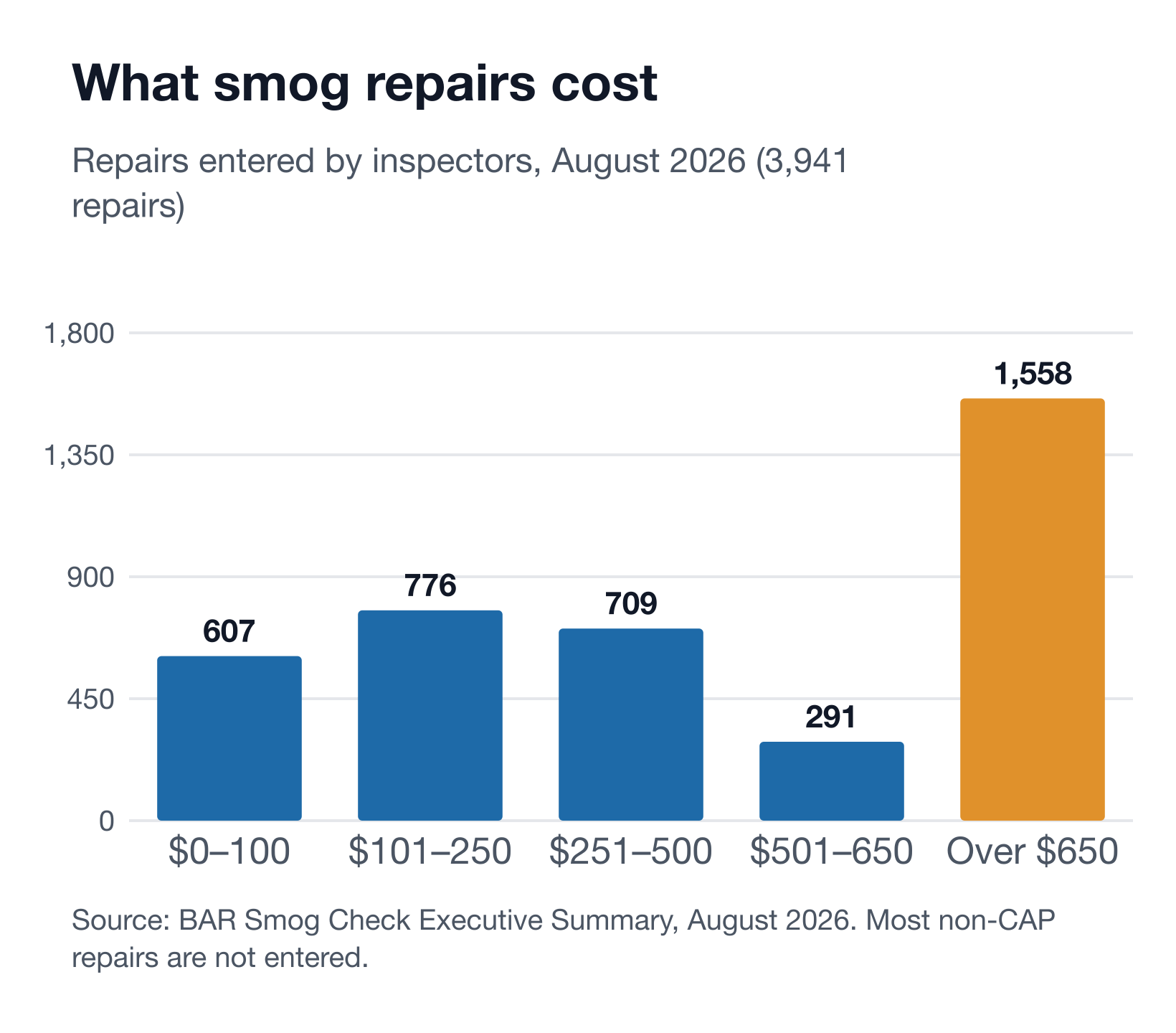
Smog check repairs averaged $783.13 across the 3,941 repairs inspectors entered in BAR's August 2026 report. The spread is wide: 607 cost $100 or less and 776 cost $101 to $250, while 1,558 cost more than $651, averaging $1,597.09. BAR notes most non-CAP repairs are never entered, so treat these as a rough guide.
| Where the repair was done | Repairs | Average cost |
|---|---|---|
| STAR test-and-repair station (non-CAP) | 2,986 | $689.16 |
| Non-STAR test-and-repair station | 516 | $768.99 |
| Paid through CAP repair assistance | 439 | $1,438.88 |
| All repairs entered | 3,941 | $783.13 |
More than a third of entered repairs cost $250 or less. The Referee's list of common failure causes includes faulty sensors and vacuum leaks, not just worn converters, which is why a proper diagnosis comes first.
Is a smog check retest free in California?
A smog check retest is not free by law in California. No state rule requires a station to retest a failed car at no charge. Many stations offer a free or discounted retest within a set window as their own policy, sometimes only if they did the repair. Ask before you pay for the repair or the retest.
Where you retest depends on the original notice. If the DMV renewal notice says STAR, or the car failed as a gross polluter, only a STAR station or the Referee can certify it. Otherwise any test-and-repair or test-only station works. A smog check coupon at another station may cost less than a paid retest at the first one.
Can the state help pay for smog check repairs?
The state can help pay for smog check repairs through BAR's Consumer Assistance Program (CAP). Income-eligible owners, at or below 225% of the federal poverty level, can get up to $1,450 toward repairs on 1996 and newer vehicles and up to $1,100 on 1976 to 1995 vehicles, after the car fails its biennial smog check.
How the co-pay works on a 1996 or newer car, using BAR's formula:
- Up to $1,812.50 in diagnosis and repairs, you pay 20%. On $1,000, you pay $200.
- Above $1,812.50, CAP pays $1,450 and you pay the rest. On $2,000, you pay $550.
The rules that trip people up: the car must not be registered to a business, its registration must not be expired more than 365 days, repairs happen at a STAR test-and-repair station, and nothing is reimbursed if work starts before the eligibility letter. Funding runs by fiscal year and can run out.
Retiring the car instead
If the repair costs more than the car is worth, CAP pays $2,000 to retire it if you are income-eligible and it failed its most recent smog check, $1,500 if you are income-eligible and it had any smog check within 180 days, or $1,350 with no income test after a failure. The car must drive under its own power, and the $2,000 and $1,350 options also require no registration lapse over 120 days in the prior two years; the $1,500 option accepts other proof of California use, such as insurance or repair records. Details are in our Consumer Assistance Program guide.
How does the California smog check repair cost waiver work?
The California smog check repair cost waiver lets a car that still fails after at least $650 of emissions repairs renew its registration now and finish repairs later. The repairs must be done at a licensed test-and-repair station, and only the Smog Check Referee can issue the waiver. It postpones the certificate requirement for up to two years.
A car that fails the visible smoke test qualifies only if the owner's household income is at or below 225% of the federal poverty guidelines.
The steps, from the Referee:
- Fail a smog check at a licensed station and keep the paperwork.
- Spend at least $650 on emissions-related diagnosis and repairs at a licensed test-and-repair station. CAP-paid work counts, regular smog tests do not.
- Retest. If the car still fails, book a virtual Referee appointment to submit the documents, followed by an in-person inspection.
The limits are strict. A waiver is one per vehicle per registered owner, renewal only (not a sale or first California registration), and it is refused for missing, modified or disconnected equipment. The car must pass at its next required smog check. Referees issued 58 repair cost waivers in August 2026.
Can you get a smog check extension in California?
California has no general smog check extension. The closest options run through the Smog Check Referee. The repair cost waiver gives up to two more years after $650 of repairs, and a parts exemption, valid 90 days, can apply when a required emissions part is confirmed unavailable. BAR's August 2026 report also shows two hardship extensions issued.
BAR does not publish hardship extension criteria on the pages we checked, so ask the Referee directly. The parts route requires a renewal-cycle failure, a documented diagnosis tying the failure to the missing part, and a search of suppliers first. The Referee's Parts Locator Service helps with the search.
When should you take a failed car to the Smog Check Referee?
Take a failed car to the Smog Check Referee after it has been properly diagnosed at a licensed station and you still believe it should pass, or when you need a repair cost waiver, a parts exemption, or a gross polluter certification with no STAR station nearby. The Referee does not diagnose or repair cars. Book at 1-800-622-7733.
Referee stations see hard cases: 68.73% of on-board computer initial tests there failed in August 2026. Payment is by Visa or Mastercard only. Our Smog Check Referee guide covers booking and what to bring.
Once the car passes, the certificate goes to DMV electronically and stays valid for 90 days. Confirm it on our smog check history lookup, or find a station for your retest on the smog check near me page.
Sources: BAR Smog Check Executive Summary, August 2026 · BAR: Smog Check · BAR: CAP repair assistance · BAR: CAP vehicle retirement · BAR Smog Check Reference Guide · Smog Check Referee: Repair cost waivers · Smog Check Referee: Parts Locator Service
Figures checked against BAR, DMV and CARB sources as of October 2026.