Check Engine Light On? What It Means for Your Smog Check
Thursday, July 23, 2026 · Updated · Fact-checked against official sources
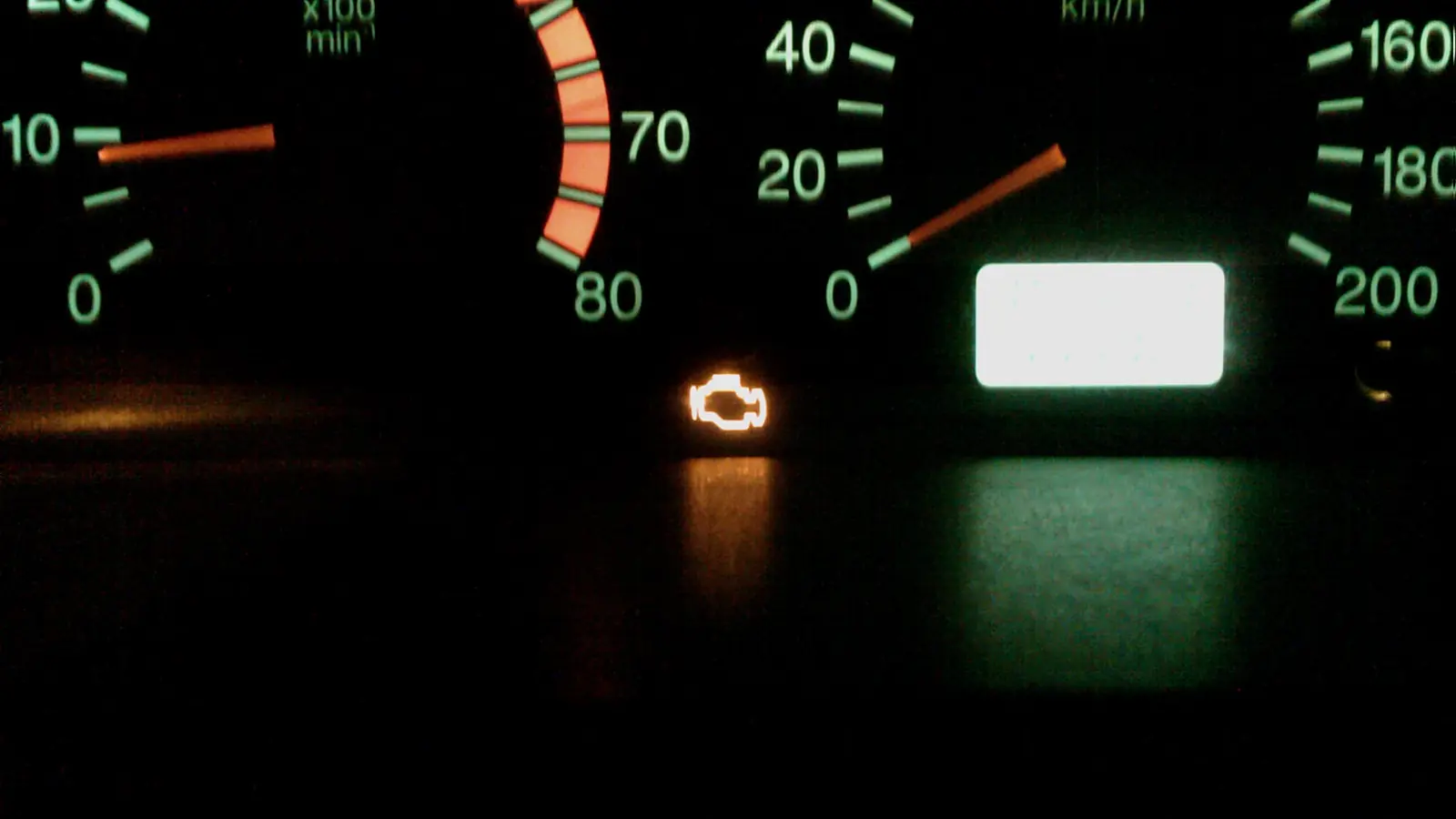

You cannot pass a California smog check with the check engine light on. BAR's procedure fails any car whose light stays on or flashes with the engine running, and also a car whose light never comes on. In BAR's August 2026 report, 6.63% of on-board computer tests failed the OBD-II check, 3.93% on readiness monitors alone.
The fix is the same in almost every case: find the fault, repair it, then drive the car until its self-tests finish. Here is how each piece works.
Can you pass a smog check with the check engine light on?
You cannot pass a California smog check with the check engine light on. BAR's Smog Check Manual tells inspectors to fail the malfunction indicator light if it stays lit or flashes with the engine running. Tailpipe readings do not matter, and BAR states plainly that "a vehicle will not pass a Smog Check with the check engine light on."
The light means the car's own computer has found an emissions-related fault and stored a diagnostic trouble code. On most 2000 and newer gasoline cars there is no tailpipe probe at all, so the computer's report is the test.
BAR's advice is simple: if the light is on, get the car repaired before the smog check. Paying for an inspection you already know will fail only adds a failed result to the car's history.
Why does a check engine light that never comes on fail smog?
A check engine light that never comes on fails a California smog check because the inspector must see the warning lamp work. With the key on and the engine off, the light should illuminate, then go out once the engine starts. A light that does not illuminate at all fails, since a dead bulb could hide a real fault.
Test this yourself before you book. Turn the key to "on" without starting the engine and watch the dashboard. Keyless and push-button cars may need the manufacturer's procedure for this "key on, engine off" position.
Do not confuse the check engine light with a maintenance reminder for an oil change. BAR's manual says maintenance reminders are not part of the smog check.
What does a smog check read from the car's computer?
A California smog check reads the car's computer through the OBD-II diagnostic connector, usually under the dashboard. The inspection system checks whether the computer communicates, whether readiness monitors are complete, which trouble codes are stored, the vehicle identification, signs of software modification and whether the computer is commanding the check engine light on.
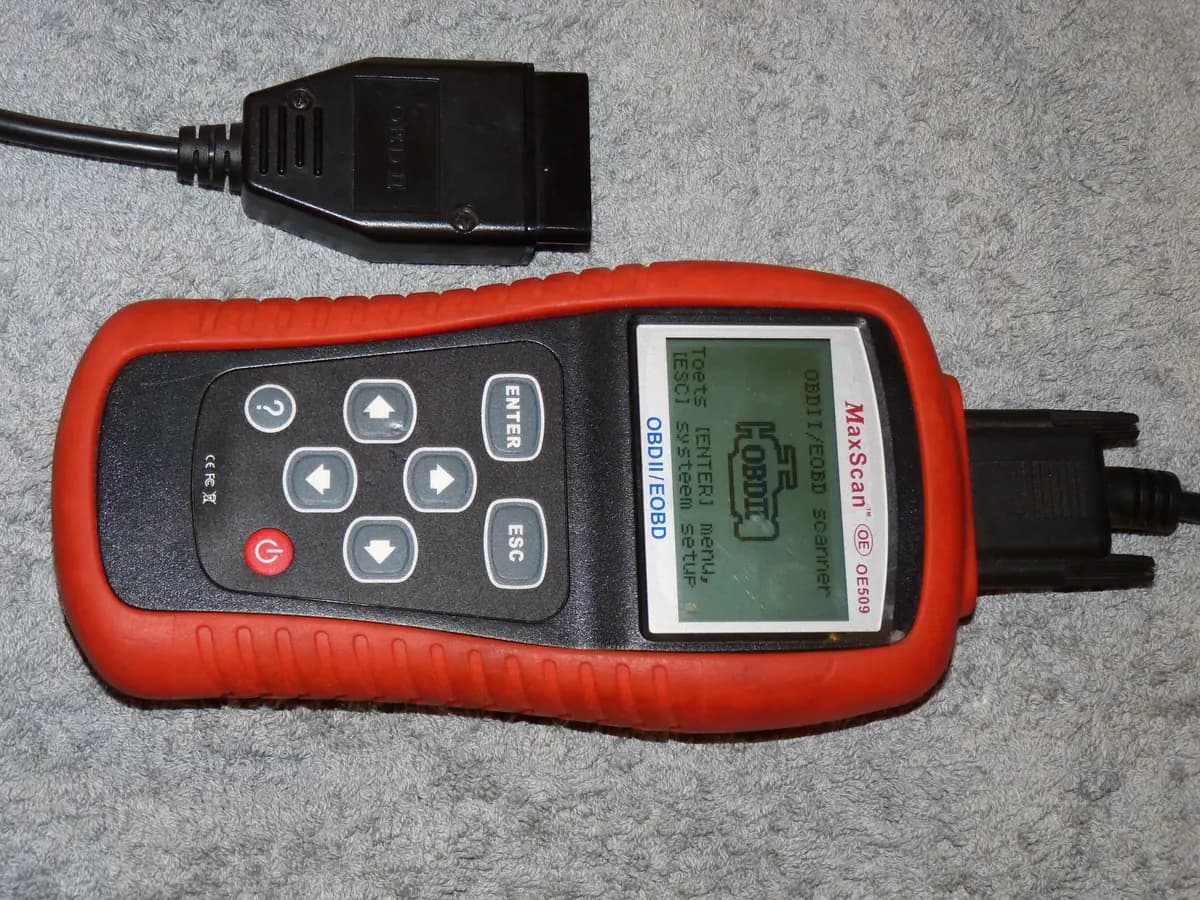

You can read the same data yourself with an inexpensive scan tool. It shows the trouble code and the monitor status, which is useful before you pay for a test. A code names a system, such as the catalyst, an oxygen sensor, the evaporative system or a misfire. It is a starting point for diagnosis, not a parts list. For the rest of the inspection, see what happens during a smog check.
What is the difference between a steady and a flashing check engine light?
A steady check engine light means the car has stored an emissions fault. A flashing check engine light is usually more urgent. Owner's manuals commonly describe it as a misfire severe enough to damage the catalytic converter. Either one fails a California smog check, because BAR's procedure fails a light that stays on or flashes with the engine running.
With a steady light, schedule a diagnosis. With a flashing light, follow your owner's manual, which typically says to reduce driving and have the car checked promptly. Driving hard on a misfire can turn a cheap ignition repair into a much larger catalytic converter bill.
What are readiness monitors, and how many can be incomplete?
Readiness monitors are self-tests the car's computer runs on emissions systems such as the catalyst, oxygen sensors and evaporative system. A California smog check fails a car with too many unfinished monitors, even with no warning light. BAR's limits allow one incomplete monitor on 1996 to 1999 gasoline cars and only the evaporative monitor on 2000 and newer gasoline cars.
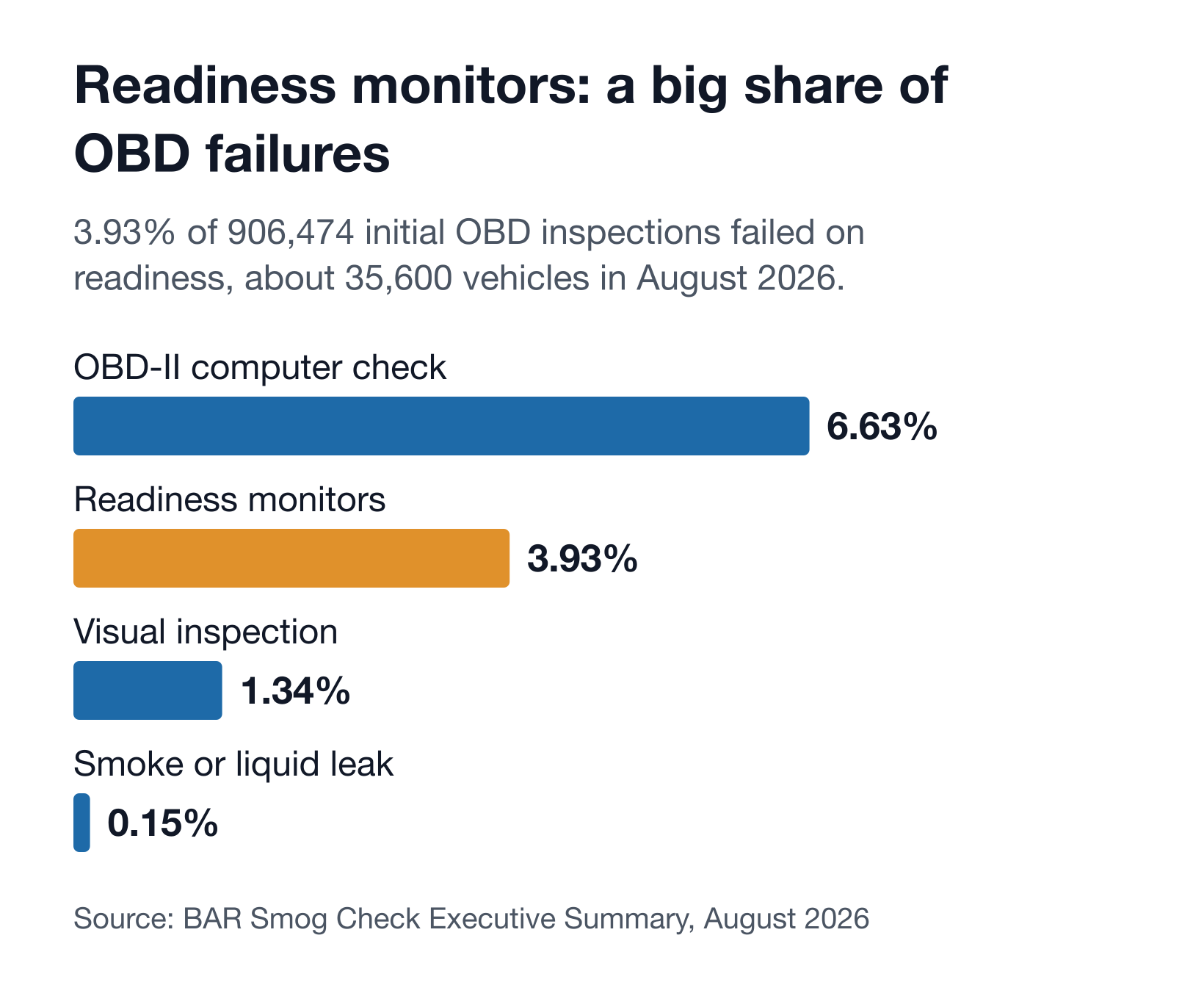
Readiness alone accounted for 3.93% of the 906,474 on-board computer initial tests in BAR's August 2026 report. That is more than half of all OBD-II failures, and the Referee notes a car can fail on readiness with no check engine light on at all.
These are the current allowances published by the Smog Check Referee:
| Vehicle | Incomplete monitors allowed |
|---|---|
| 1996 to 1999 gasoline | Any one |
| 2000 and newer gasoline | Evaporative system only |
| 1998 to 2006 diesel | None |
| 2007 and newer diesel | Particulate filter and NMHC catalyst only |
What changed on October 1, 2025?
A BAR regulation effective October 1, 2025 requires every readiness monitor that can feasibly be set to be complete. BAR said it would keep the limits above while it collects data, change them only where monitors can reasonably be expected to complete, and announce any change well in advance. Some vehicles may never change, and BAR will grant exceptions for unusual designs.
Why is my car "not ready" after a battery replacement?
A car shows "not ready" for a California smog check after a battery replacement because disconnecting the battery erases the computer's memory, including readiness monitor results. Clearing trouble codes with a scan tool or repairing an emissions part does the same. BAR advises driving the car for a week or two so the monitors can finish before the smog check.
The same reset is why clearing the check engine light the morning of a test backfires. The light goes out, the fault stays, and the car fails for incomplete monitors instead. You also lose the stored codes the next technician needed.
If the battery was replaced recently, ask the station to check monitor status before running the official test, or check it yourself with a scan tool.
How do you complete a drive cycle for a smog check?
A drive cycle for a California smog check is the set of driving conditions a car's computer needs before each readiness monitor will run. The conditions differ by make and model, so the reliable source is the manufacturer's service information. For most cars, a week or two of normal mixed driving, with cold starts and highway stretches, completes them.
Some practical points:
- Mix trip types: a cold start after the car sits overnight, city driving, and some steady cruising at highway speed.
- Check progress with a scan tool rather than guessing.
- Do not clear codes partway through, or you start over.
The Referee warns that some cars will not run all their monitors, even after hundreds of miles, until the underlying fault is properly diagnosed and repaired. If a shop's only advice is to "drive it more," a second opinion from a repair shop familiar with readiness and drive cycle issues is reasonable. The Referee also helps drivers who cannot meet the readiness requirements. It completed 25 inspections for OBD monitor issues in August 2026. Our Smog Check Referee guide explains how to book.
What should you do when the check engine light comes on before a smog check?
When the check engine light comes on before a California smog check, get the code read, have the fault repaired at a licensed station, and drive until the monitors finish. Check emissions warranty coverage first. California-certified cars must be warranted to pass smog for 3 years or 50,000 miles, and high-priced emissions parts for 7 years or 70,000 miles.
Warranty repairs after a smog failure must still be done by a licensed smog check repair-only or test-and-repair station, and you can choose to take the car to the dealer. Partial zero emission vehicles (PZEV) carry a 15-year or 150,000-mile emissions warranty. A test-only station cannot diagnose or repair the car, as explained in test-only vs test-and-repair stations.
If the repair bill is the obstacle, BAR's Consumer Assistance Program pays up to $1,450 toward emissions repairs on 1996 and newer vehicles for income-eligible owners. If the car has already failed, follow what to do after a failed smog check. For prep beyond the light, see how to pass a California smog check.
When the light stays off and the monitors read ready, find a station on the smog check near me page, and confirm the result later on our smog check history lookup.
Sources: BAR: Smog Check · BAR: New OBD readiness monitor regulations · BAR Smog Check Executive Summary, August 2026 · BAR Smog Check Manual · BAR Smog Check Reference Guide · Smog Check Referee: OBDII monitor readiness concerns
Figures checked against BAR, DMV and CARB sources as of October 2026.