Gross Polluter: What It Means and How to Fix It
Thursday, July 30, 2026 · Updated · Fact-checked against official sources

A gross polluter is a vehicle whose tailpipe emissions exceed California's gross polluter standards, set well above ordinary limits. It is a BAR-97 tailpipe result, so it mostly hits 1999 and older cars: 2.53% of BAR-97 initial tests failed as gross polluters in August 2026. After repair, only a STAR station or the Smog Check Referee can certify the car.
The designation sounds worse than it is. It changes where the car can be certified, not whether it can be fixed.
What does gross polluter mean on a California smog check?
Gross polluter on a California smog check means the vehicle's measured tailpipe emissions exceeded the gross polluter standards in BAR's regulations, a separate, higher threshold than an ordinary emissions failure. The Smog Check Referee describes it as a car that "pollutes much more than a typical vehicle that fails," with the cutoff varying by vehicle type and model year.
The tailpipe test measures pollutants such as hydrocarbons (unburned fuel) and carbon monoxide. In enhanced areas, most 1976 to 1999 cars run on a dynamometer so the analyzer can also measure oxides of nitrogen (NOx). Exceeding the gross polluter level on the initial test is what earns the label.
A gross polluter result is still a failed smog check. Everything in what to do after a failed smog check applies, plus one extra restriction on where the car can be certified.
Which cars can be labeled gross polluters?
Only cars that get the BAR-97 tailpipe test can be labeled gross polluters in California. That means 1976 to 1999 gasoline vehicles, plus a small number of newer ones without OBD-II, over 14,000 pounds GVWR, or flagged by BAR for problematic OBD-II systems. Most 2000 and newer cars get the on-board computer test, which has no gross polluter category.
The rate climbs sharply with age. In BAR's August 2026 report, 8.48% of 1976 model year cars and 8.56% of 1977 cars failed as gross polluters, compared with 4.77% of 1985 cars, 2.43% of 1995 cars and 1.06% of 1999 cars.
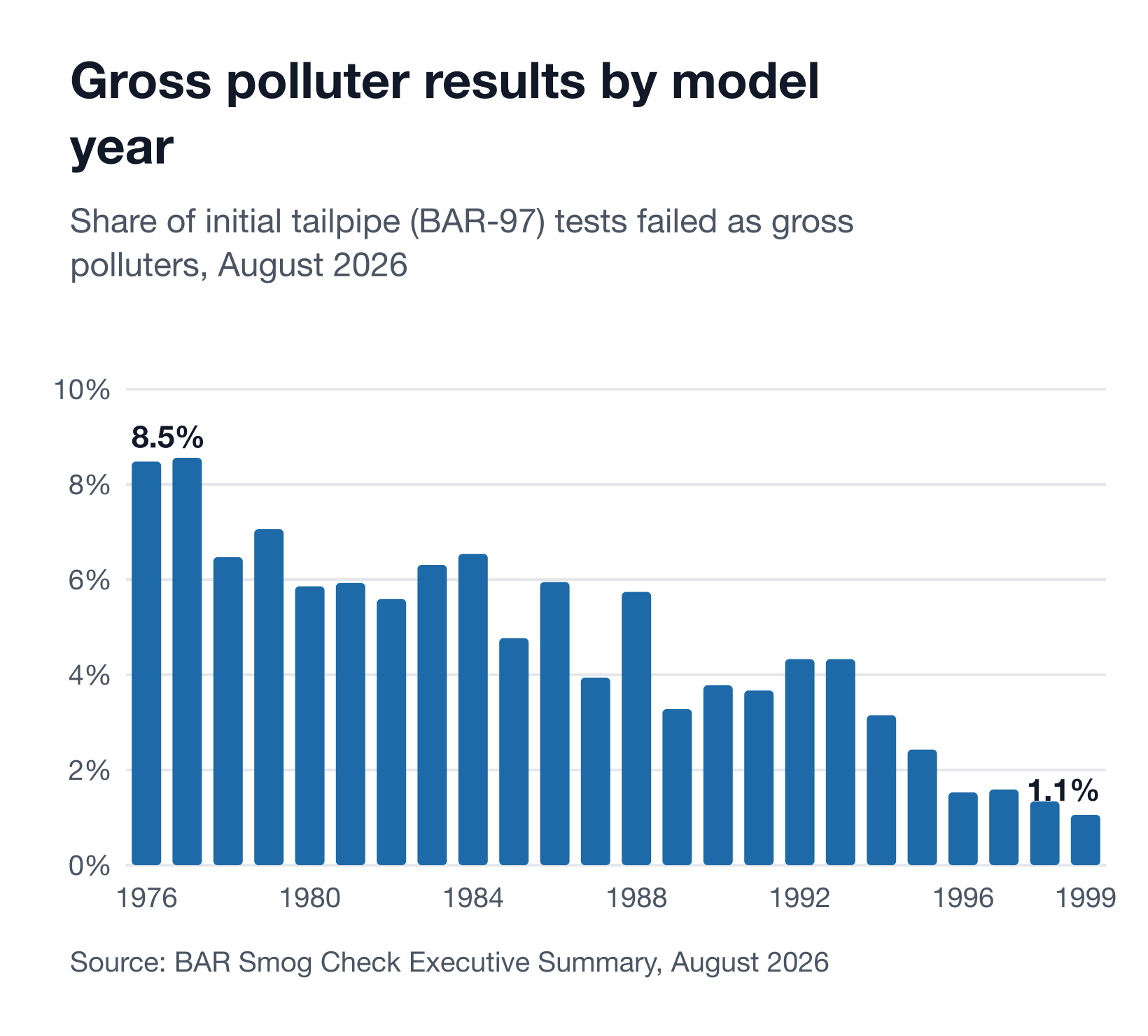
| Model year | BAR-97 initial tests | Gross polluter rate |
|---|---|---|
| 1976 | 283 | 8.48% |
| 1977 | 397 | 8.56% |
| 1985 | 839 | 4.77% |
| 1995 | 4,028 | 2.43% |
| 1999 | 9,846 | 1.06% |
| All years | 62,489 | 2.53% |
If you drive a 2015 crossover, this label almost certainly does not apply to you. If you drive a car from the 1980s, it is a real risk worth planning around.
Where can you get a gross polluter certified?
A gross polluter can be certified in California only at a STAR test-only station, a STAR test-and-repair station, or, when applicable, a BAR Referee station. The Referee route is for areas with no STAR station nearby. Ordinary non-STAR stations cannot certify it, and BAR's inspection system blocks the test when it can check the vehicle's record.
Any test-and-repair station can still do the repair work. It just cannot issue the certificate afterward unless it is STAR certified.
As of October 2026, 3,100 stations in our directory are STAR certified. You can find them through our STAR smog check guide or a city STAR page such as STAR stations in Los Angeles. A STAR test-only station is also a useful second opinion, since it has no repair work to sell. We compare the two types in test-only vs test-and-repair stations.
What causes a car to fail as a gross polluter?
A car fails as a gross polluter when something in the engine or emissions system is badly wrong, not marginally out of adjustment. The pollutant that failed points to the cause: high hydrocarbons usually mean unburned fuel, high carbon monoxide a rich fuel mixture, and high NOx overly hot combustion or a failed control system such as EGR.
Typical places a technician looks:
- High hydrocarbons: misfires from worn ignition parts, leaking injectors, low compression, or a converter that has stopped working.
- High carbon monoxide: a failed oxygen or temperature sensor, a stuck injector, a clogged air filter, or on very old cars a carburetor out of adjustment.
- High NOx: a blocked or inoperative EGR system, overheating, or a converter that no longer reduces NOx.
A dead catalytic converter is often the expensive symptom of a cheaper problem left unfixed, such as a long-running misfire. BAR's STAR guidance warns against "masking a fuel system problem with a new catalytic converter," so make sure the shop finds the cause, not just the damage.
How do you fix a gross polluter and pass the retest?
To fix a gross polluter, have the car diagnosed and repaired at a licensed test-and-repair or repair-only station, confirm the repair, then retest at a STAR station. Test-and-repair stations can use the inspection system's pre-inspection mode to check their work first. Pre-inspections are exempt from gross polluter requirements, so a bad pretest adds no restrictions.
Gross polluters are eligible for state help, except government and permanently registered fleet vehicles:
- CAP repair assistance: up to $1,100 for 1976 to 1995 cars and up to $1,450 for 1996 and newer, for owners at or below 225% of the federal poverty level. On a 1976 to 1995 car you pay 20% of a bill up to $1,375; above that, CAP pays $1,100 and you pay the rest. Repairs must be at a STAR test-and-repair station, after the eligibility letter arrives.
- CAP vehicle retirement: $2,000 or $1,500 for income-eligible owners, or $1,350 with no income test after a failure. The car must drive under its own power.
- Repair cost waiver: after at least $650 of emissions repairs at a licensed test-and-repair station, a car that still fails at renewal may qualify for a one-time waiver from the Referee.
Our Consumer Assistance Program guide covers CAP eligibility, and the Smog Check Referee guide covers the waiver.
Does a gross polluter result stay on the car's record?
A gross polluter test stays in the car's California inspection history, which anyone can search by license plate or VIN on BAR's website. A later passing retest is recorded as well, so a buyer can see both results. The failed initial test does not disappear when the car is repaired.
That matters when you sell. A careful buyer checking the record will see the failed test and may ask what was fixed, so keep the repair invoices. You can pull the history yourself on our smog check history lookup.
If you are the buyer, a gross polluter result on an older car is a reason to ask questions and get an inspection before you pay. Checking a used car's smog history takes a couple of minutes.
How can you avoid a gross polluter result?
You avoid a gross polluter result on an older California car by fixing obvious running problems before the test and considering a pre-inspection. A misfire, rough idle or fuel smell on a 1999 or older car can push tailpipe readings far over the limit. The Referee's own advice is that regular oil changes and servicing improve the odds of passing.
A pre-inspection runs the same tailpipe test without a certificate and without the gross polluter restriction. Ask the station for an estimate first. For a full prep checklist, see how to pass a California smog check, and compare nearby STAR options on the smog check near me page.
Sources: BAR Smog Check Executive Summary, August 2026 · BAR Smog Check Reference Guide · BAR Smog Check Manual · BAR: STAR FAQ · BAR: CAP repair assistance · BAR: Check inspection history · Smog Check Referee: FAQ
Figures checked against BAR, DMV and CARB sources as of October 2026.