STAR vs Test-Only vs Test-and-Repair Smog Stations
Wednesday, June 24, 2026 · Updated · Fact-checked against official sources
,_Bestanddeelnr_921-7200.jpg)
A test-only smog station inspects your car but cannot repair it; a test-and-repair station can inspect, diagnose and fix it. STAR is a separate BAR certification that either type can hold. As of October 2026, our directory lists 1,971 test-only stations, 78% of them STAR, and 3,981 test-and-repair stations, 39% of them STAR.
Your DMV renewal notice decides whether you need STAR. Which license type you pick is up to you. Here is how the three fit together, what each costs, and when each one makes sense.
What is a test-only smog station?
A test-only smog station in California is licensed to perform Smog Check inspections and nothing else. BAR's reference guide says no repairs or diagnoses happen there, apart from free minor fixes like reconnecting a vacuum hose. It also may not refer you to a particular repair shop. Any driver can use one, and most are STAR certified.
After a failure, a test-only station must point you to BAR's list of licensed repair stations, which is the Auto Shop Locator on bar.ca.gov. You leave with the vehicle inspection report, which shows the results and whether the car passed or failed.
The rule keeps the inspection separate from the repair bill. A station that earns nothing from repairs has no reason to fail a car that should pass.
What is a test-and-repair smog station?
A test-and-repair smog station in California is licensed to inspect vehicles and, when needed, diagnose, adjust and repair them, then retest. It is the one-stop option: if the car fails, the same shop can quote the fix and run the next inspection. A certificate from a test-and-repair station is identical to one from a test-only station.
Without STAR certification, a test-and-repair station cannot certify directed vehicles or gross polluters. It can still repair them, but BAR's reference guide says it must send them back to a STAR station for the certificate.
There is also a third license, repair-only, for shops that fix emissions problems but cannot run official inspections.
What is a STAR smog check?
A STAR smog check is the same inspection as any other, done at a station that BAR has certified for meeting higher performance standards. STAR began January 1, 2013, replacing the old Gold Shield program. Only STAR stations may certify directed vehicles and gross polluters, and both STAR test-only and STAR test-and-repair stations can do it.
BAR scores stations and their inspectors on inspection-based measures, such as how the cars they certify fare at the next inspection compared with similar cars statewide. Stations that slip can have STAR suspended; in our directory, 314 stations show a suspended STAR certification as of October 2026. Our STAR smog check guide covers the program in full, including STAR stations by city such as Los Angeles STAR stations.

| Station type (our directory, October 2026) | Stations | STAR certified | STAR share |
|---|---|---|---|
| Test-only | 1,971 | 1,535 | 78% |
| Test-and-repair | 3,981 | 1,563 | 39% |
BAR's own August 2026 license count is similar in shape: 1,740 STAR test-only, 1,778 STAR test-and-repair, 2,372 non-STAR test-and-repair and only 425 non-STAR test-only stations.
STAR station vs regular smog check: which do you need?
You need a STAR station only when your DMV renewal notice says "Smog Certification Required at a STAR station," or when your car has been identified as a gross polluter. Otherwise, a regular smog check at any licensed test-only or test-and-repair station is valid. A STAR station can still test any car if you prefer one.
BAR directs cars to STAR stations in two ways:
- Profile. A statistical model flags vehicles more likely than others to fail.
- Random sample. BAR randomly selects 2% of vehicles in Enhanced areas for program evaluation.
Being directed is not a judgment on how you maintain the car. Either STAR type satisfies the notice, and a state Referee can also certify a directed car when applicable.
What if you take a directed car to a non-STAR station?
BAR's inspection manual says a station that cannot certify directed vehicles must check the DMV paperwork and tell you about the restriction before testing. When the inspection system can reach BAR's database, it blocks the test outright. Bring your renewal notice and call ahead so you do not lose the trip.
How much does a test-only smog check cost?
A test-only smog check in California averaged $63.34 at STAR test-only stations and $58.97 at non-STAR test-only stations in BAR's August 2026 Executive Summary. Test-and-repair stations averaged more: $71.03 for STAR and $74.36 for non-STAR. Every station must also charge the $8.25 state certificate fee on a pass.
| Station type | Average inspection price, August 2026 |
|---|---|
| Non-STAR test-only | $58.97 |
| STAR test-only | $63.34 |
| STAR test-and-repair | $71.03 |
| Non-STAR test-and-repair | $74.36 |
| All stations | $69.16 |
BAR notes that stations self-report these prices and they "may or may not include any discounts." Coupons often beat the averages: the special prices in our directory had a median of $39.75 as of October 2026. Compare smog check coupons, see our full breakdown of what a smog check costs in California, or compare coupon prices by county in the California smog check price report.
Where do most California smog checks happen?
Most California smog checks happen at STAR test-only stations. In August 2026, BAR counted 557,682 initial tests at STAR test-only stations, about 58% of the total, compared with 256,681 at STAR test-and-repair, 112,555 at non-STAR test-and-repair and 37,218 at non-STAR test-only stations. Directed cars went only to STAR stations.
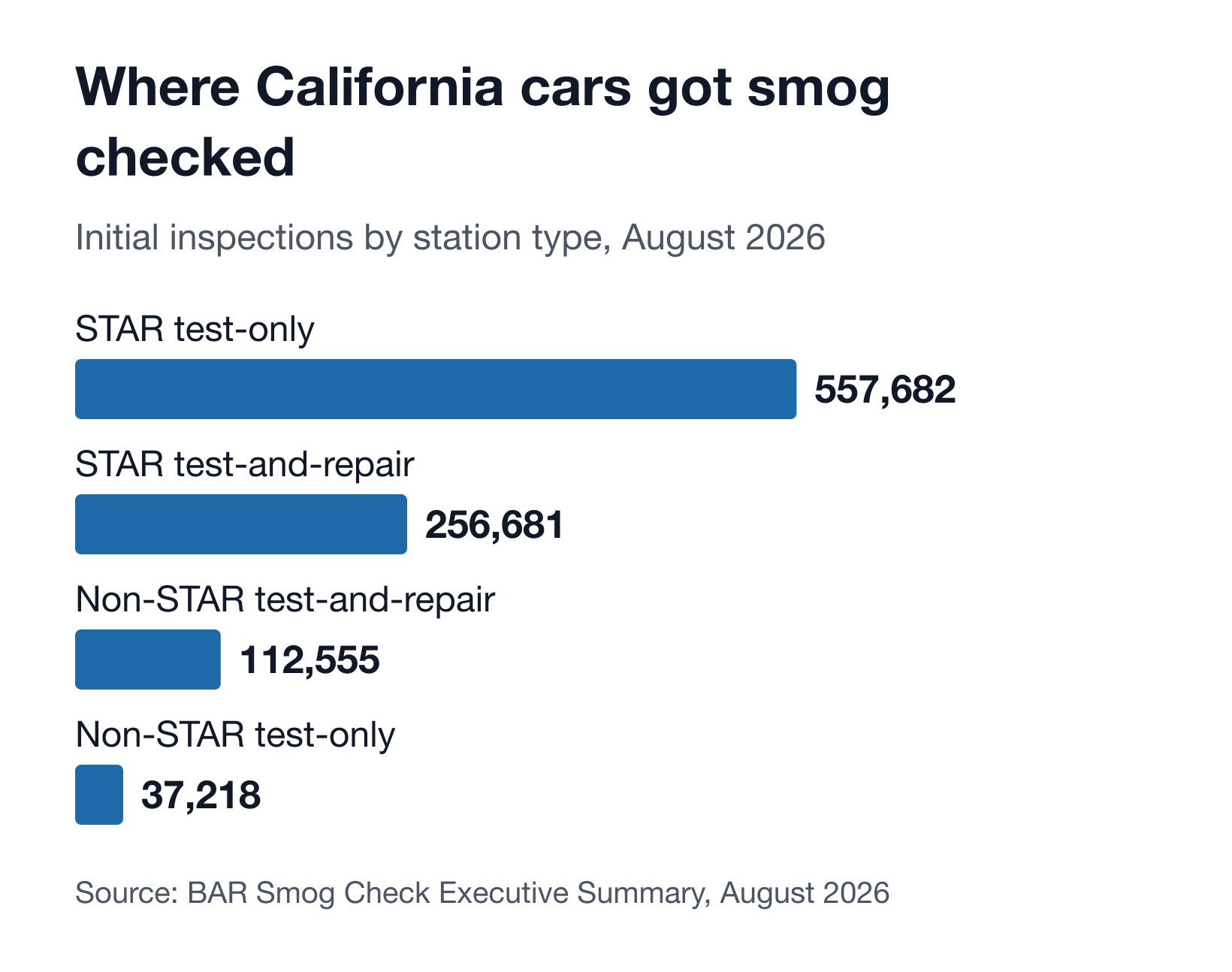
Directed vehicles explain part of that lead. Of the initial tests at STAR test-only stations, 230,318 were directed cars; STAR test-and-repair stations handled 90,627. Non-STAR stations handled none.
Why won't a test-only station tell you what's wrong?
A test-only smog station will not tell you what to fix because California law bars it from diagnosing or repairing vehicles and from steering you to a particular repair shop. It hands you the vehicle inspection report showing what failed and points you to BAR's list of licensed repair stations. The diagnosis comes from a repair shop.
Take that inspection report to a mechanic you trust or to a test-and-repair station. Our guide on what to do after a failed smog check explains the next steps, and our post on gross polluters covers the more serious result.
Which station type should you choose?
Choose a test-only station when you want an inspection from a shop with no repair business riding on the outcome, or you already have a mechanic. Choose a test-and-repair station when the car may fail and you want one shop to fix and retest it. For a healthy newer car with no warning lights, pick whichever is closest and cheapest.
A few things tip the choice:
- State repair help. BAR's Consumer Assistance Program pays for repairs only at STAR test-and-repair stations operating under a CAP agreement. Eligible owners can get up to $1,450 for 1996 and newer cars; see our Consumer Assistance Program guide.
- Retests. After a fail at a test-only station, your own mechanic can fix the car but, without a smog license, cannot certify it. You go back for a second inspection. California has no state-mandated free retest, so ask about the station's policy before the first test.
- Problem cars. A state Smog Check Referee handles cases ordinary stations cannot, such as disputed results and unusual vehicles.
Start with the smog check near me page or the statewide station directory and filter by station type or STAR.
Sources: BAR: Smog Check · BAR: STAR program FAQ · BAR Smog Check Executive Summary, August 2026 · BAR: Consumer Assistance Program repairs · DMV: Smog inspections
Figures checked against BAR, DMV and CARB sources as of October 2026.