Smog Check for Registration Renewal: When It's Due
Thursday, July 9, 2026 · Updated · Fact-checked against official sources
_-_NARA_-_553020.jpg)
In California you need a smog check every other year to renew your registration once a gas or hybrid car is past its first eight model years. As of October 2026, that means 2018 and older models in a smog check county. Your DMV renewal notice says when; get tested within the 90 days before expiration.
The rest of this post explains how the cycle is set, what the notice is telling you, and the timing mistakes that cost people a second inspection fee.
How often do you need a smog check in California?
A California vehicle subject to Smog Check needs an inspection every other year at registration renewal, plus one at most changes of ownership and when first registered in the state. Registration renews yearly, so the smog requirement shows up on every second renewal notice. New gas and hybrid cars skip renewal tests for eight model years.
The biennial requirement applies in the 34 counties the DMV lists as smog check counties at renewal, including Los Angeles, Orange, Ventura, Sacramento, Fresno, Kern, Santa Clara and Alameda. Some counties are only partly covered by ZIP code, which is one more reason to trust the notice over a guess.
Diesels are different. A 1998 or newer diesel up to 14,000 lb GVWR has no new-car exception and is tested every other year from the start. See our diesel smog check guide.
Do I need a smog check to renew my registration?
You need a smog check to renew your California registration only when the DMV renewal notice says so. BAR lists the two messages to look for: "Smog Certification Required" and "Smog Certification Required at a STAR station." If neither line appears, no inspection is due this year and you can renew without one.
The notice reflects what the DMV knows about your vehicle: its model year, its inspection history and whether BAR has directed it to a STAR station. The DMV sends the billing notice about 60 days before the registration expires. If yours never arrives, the DMV fee calculator or customer service can tell you what is due.
What the STAR line means
A notice that says "at a STAR station" means only a STAR-certified station can certify the car this cycle. BAR directs some vehicles there because a statistical model flags them as likely to fail, and picks a 2% random sample for program evaluation. Either a STAR test-only or a STAR test-and-repair station works. Our STAR smog check guide explains how to find one.
If the notice does not mention STAR, any licensed smog station can do the test.
When is a new car's first renewal smog check?
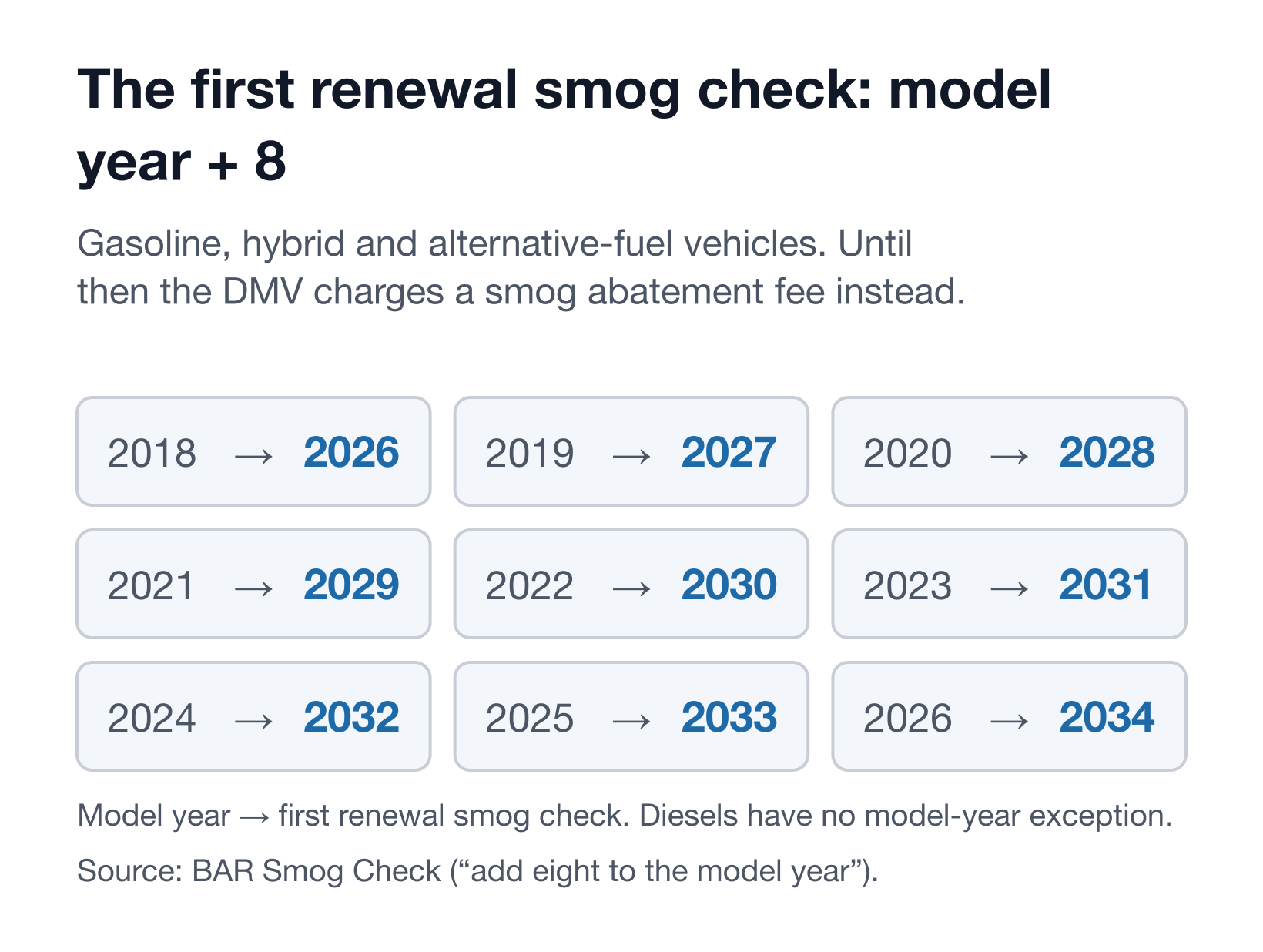
A new gasoline, hybrid or alternative-fuel car in California gets its first renewal smog check in the year equal to its model year plus eight. BAR's own example: a 2020 model-year vehicle needs a smog check for registration renewal in 2028. Until then, the DMV charges a smog abatement fee with each renewal instead of requiring a test.
| Model year | First renewal smog check |
|---|---|
| 2018 | 2026 |
| 2019 | 2027 |
| 2020 | 2028 |
| 2021 | 2029 |
| 2022 | 2030 |
| 2023 | 2031 |
| 2024 | 2032 |
| 2025 | 2033 |
| 2026 | 2034 |
The abatement fee is $20 a year for cars six model years old and newer and $25 a year in the seventh and eighth model years. For a registration expiring in 2026, that is $20 for 2021 and newer and $25 for 2019 and 2020. Our smog abatement fee guide has the details.
After that first test, the requirement comes back every other renewal. Because the first test lands in an even year for an even model year, a 2018 car tested in 2026 will normally be due again in 2028.
When should you get the smog check before renewal?
Get the smog check within the 90 days before your California registration expires. A passing smog certificate is valid for 90 days and the station sends it to the DMV electronically, so a test done too early can lapse before you renew. A test done too late leaves no time to fix a failure before the deadline.
The DMV has no grace period. Registration expires on the specific day printed on your registration card, not at the end of the month on your sticker. Penalties start the day after: a share of the vehicle license fee plus a registration late fee and a CHP late fee, growing the longer you wait.
A practical window is three to six weeks before the expiration date. That leaves room for a repair and a retest if the car fails.
What do you need to bring to the smog check?
Bring the DMV renewal notice if you have it; BAR says it helps the station confirm your vehicle details. Make sure the check engine light is off, because a car will not pass with the light on. If the battery was recently disconnected or replaced, drive normally for a week or two first so the readiness monitors can reset.
Those monitors matter more now. A BAR regulation effective October 1, 2025 requires all monitors that can feasibly be set to be complete, phased in by vehicle. Our guide on how to pass a California smog check covers the prep.
BAR does not regulate inspection prices. The statewide average was $69.16 in August 2026, and every station must also charge the $8.25 certificate fee on a pass. Coupons in our directory had a median special price of $39.75 as of October 2026, so check smog check coupons first.
What other events trigger a smog check?
Two events besides renewal trigger a California smog check: a change of ownership and registering a vehicle in California for the first time. A sale needs a pass from the last 90 days unless the car is one of the newest four model years, and a car from another state needs a smog check before it gets California plates.
Selling or buying
When a car changes hands, the seller provides a passing certificate from the last 90 days. Cars four model years old and newer (2023 and newer for a 2026 sale) skip the test, and the buyer pays an $8 smog transfer fee instead. Transfers between immediate family members are exempt. For a vehicle bought from a dealership, BAR says it "must have passed a Smog Check within the past two years." Our post on used car smog history covers the details, and you can pull any car's record with our smog check history lookup.
Moving to California
A vehicle registered for the first time in California needs a smog check, including cars bought or previously registered in another state. BAR says the inspection also confirms that aftermarket parts meet California rules. Permanently exempt vehicles, like 1975 and older gas cars and electric vehicles, are the exception; the full list is in which cars are exempt from smog check.
What if your car fails the renewal smog check?
If a car fails the renewal smog check, the DMV cannot issue the new registration until it passes, but paying the renewal fees by the due date still avoids late penalties. Read the vehicle inspection report, get the emissions repairs done, and retest at any station, or a STAR station if the notice requires one.
California has no state-mandated free retest; some stations offer one as their own policy, so ask before the first test. Income-eligible owners can apply to BAR's Consumer Assistance Program for up to $1,450 in repair help on 1996 and newer cars. Our guide on what to do after a failed smog check walks through the options, and the Consumer Assistance Program guide covers eligibility.
When it is time, find a smog check near you.
Sources: BAR: Smog Check · DMV: Smog inspections · DMV: Registration fees and penalties · BAR: OBD readiness monitor regulations · BAR: Consumer Assistance Program repairs · BAR Smog Check Executive Summary, August 2026
Figures checked against BAR, DMV and CARB sources as of October 2026.