Which Cars Are Exempt From Smog Check in California?
Wednesday, July 1, 2026 · Updated · Fact-checked against official sources
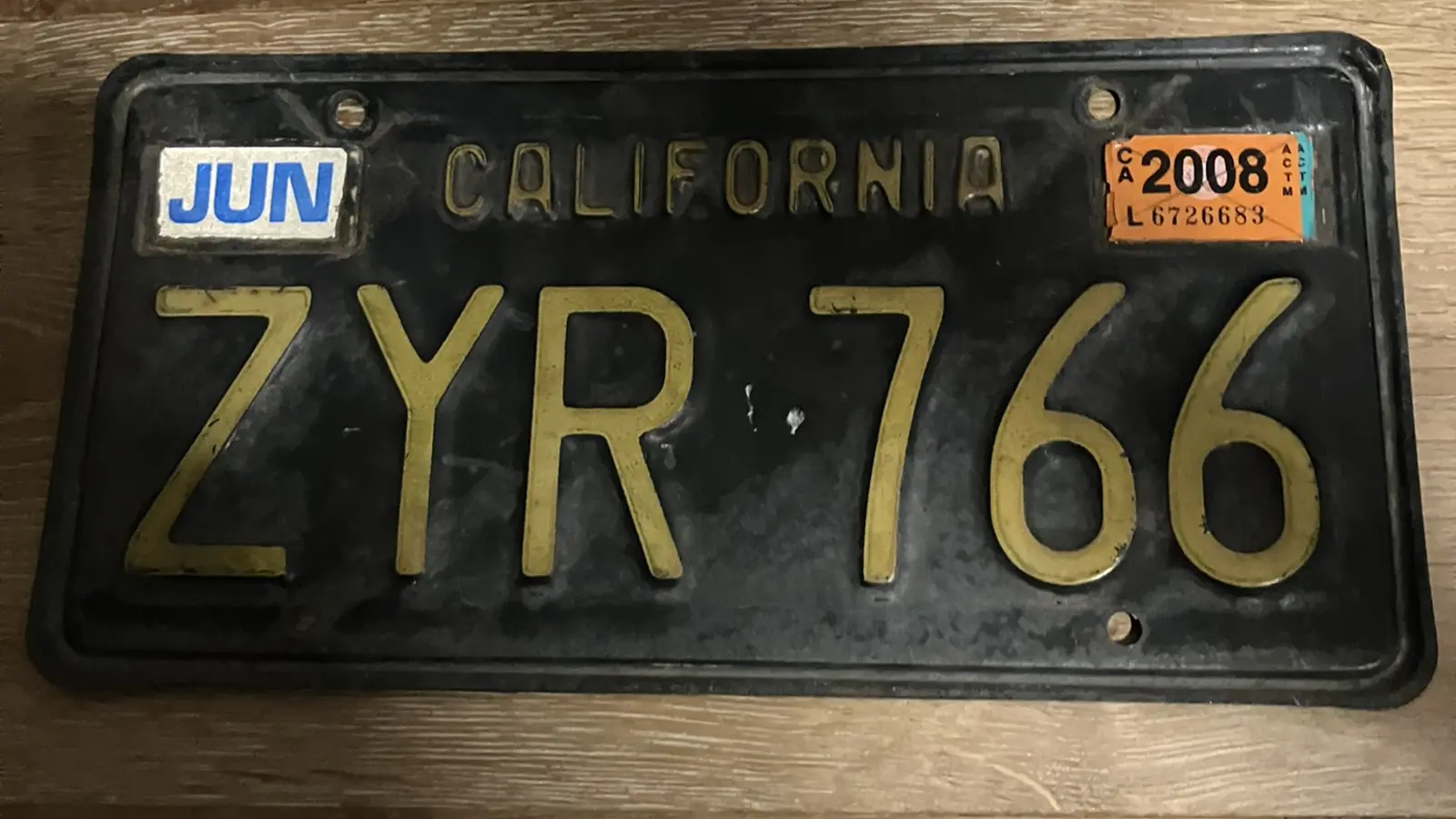

As of October 2026, a gasoline or hybrid car registered in California skips the renewal smog check if it is a 2019 or newer model, because the newest eight model years pay a smog abatement fee instead. Gas cars from 1975 and older, diesels from 1997 and older, electric vehicles and motorcycles never need one.
Everything else in a smog check county gets tested every other year. The details below cover the exceptions people trip over: sales, diesels, hybrids, collector cars and family transfers.
What is the California Smog Check program?
The California Smog Check program is the state's vehicle emissions inspection, run by the Bureau of Automotive Repair (BAR). Gasoline, hybrid and alternative-fuel vehicles from 1976 and newer, and diesels from 1998 and newer, need a passing inspection every other year at renewal, at most changes of ownership, and when first registered in California.
Where you live matters too. The DMV lists 34 counties where a smog check is required at renewal, including Los Angeles, Orange, Sacramento, Fresno, Santa Clara and Alameda. Some of those counties are only partly covered, so your DMV renewal notice is the final word. If it says "Smog Certification Required," you need one.
The inspection itself usually takes about 30 minutes. For most 2000 and newer cars it is a plug-in check of the on-board computer, and older cars get a tailpipe test. Our smog check requirements guide has the full rule set in one place.
What year cars are exempt from smog check in California?
For a registration renewal in 2026, gasoline, hybrid and alternative-fuel cars from model year 2019 and newer are exempt from the smog check, and model year 2018 gets its first renewal test this year. Gasoline cars from 1975 and older are permanently exempt. Diesels from 1997 and older or over 14,000 lb GVWR are exempt; 1998 and newer diesels up to 14,000 lb have no new-car exemption.
BAR's rule of thumb is to add eight to the model year. A 2020 car needs its first renewal smog check in 2028 (2020 + 8 = 2028). Until then the DMV adds a smog abatement fee to the registration bill.
| Model year (registration expiring in 2026) | Renewal requirement |
|---|---|
| 2021 and newer, gas or hybrid | No smog check, $20 abatement fee |
| 2019 and 2020, gas or hybrid | No smog check, $25 abatement fee |
| 1976 through 2018, gas or hybrid | Smog check every other year (2018 starts this year) |
| 1975 and older, gas | Exempt, no smog check ever |
| 1998 and newer diesel, up to 14,000 lb GVWR | Smog check every other year, no new-car exception |
| 1997 and older diesel, or over 14,000 lb GVWR | Exempt |
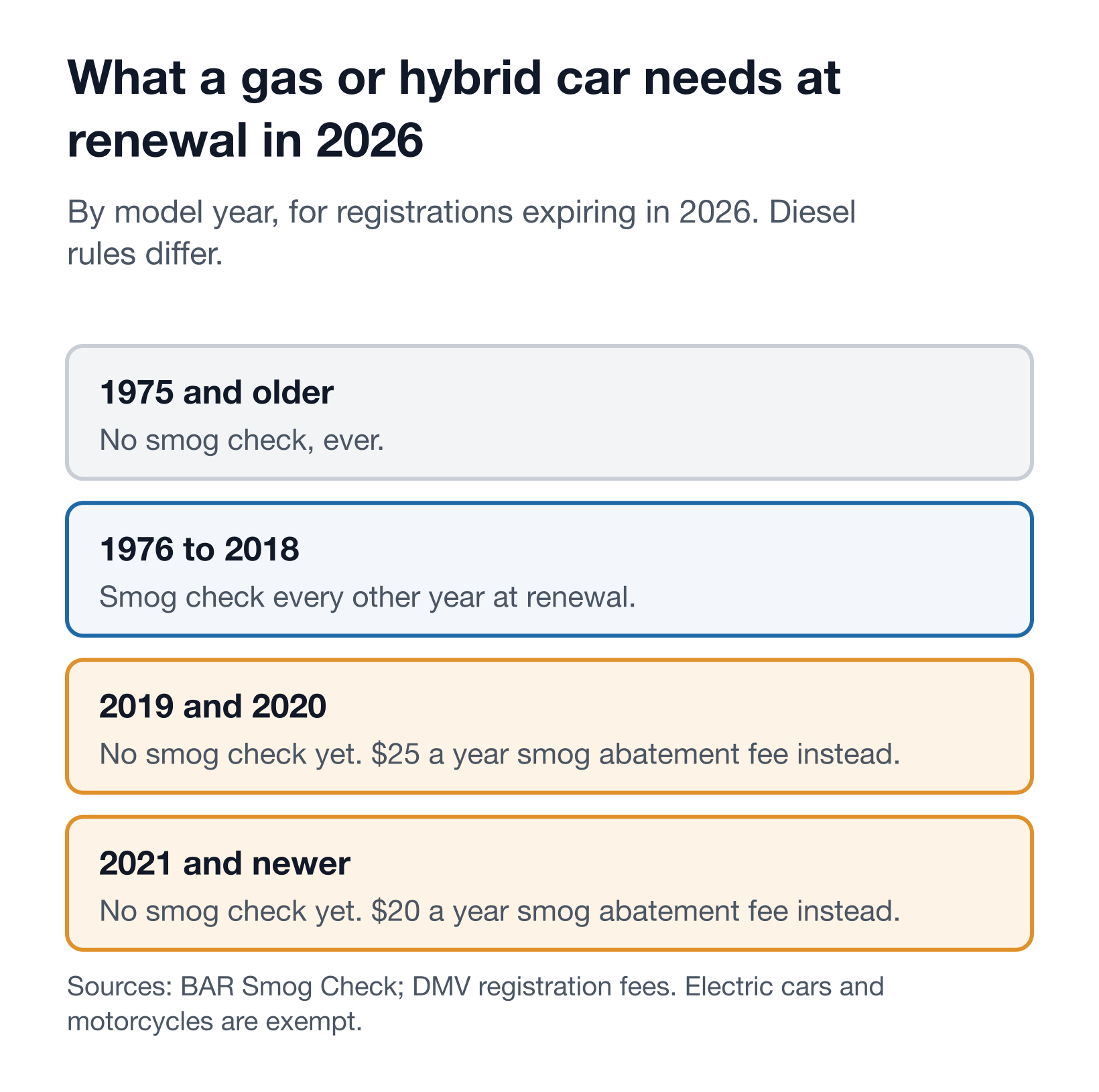
The window rolls forward every January. In 2027, model year 2019 drops out of the fee and needs its first smog check. Our smog abatement fee guide shows the next year's cutoffs.
Is a new car really exempt if it still pays a fee?
A new car in California is exempt from the smog check test, not from paying. Gas and hybrid vehicles in their first eight model years pay a smog abatement fee at every renewal: $20 a year through the sixth model year and $25 a year in the seventh and eighth. It appears on the DMV renewal notice.
The eight-year window dates to Assembly Bill 1274 (Chapter 633, Statutes of 2017). Starting January 1, 2019, it stretched the exemption from six model years to eight and set the $25 rate for the two added years.
Which vehicles never need a smog check?
Some California vehicles are exempt no matter how old they get. BAR and the DMV list gasoline vehicles from 1975 and older, diesels from 1997 and older, diesels over 14,000 lb gross vehicle weight rating, natural-gas vehicles over 14,000 lb, fully electric vehicles, and motorcycles. None of these needs a smog check at renewal or at a sale.
The 1975 cutoff is fixed, not rolling. California briefly had a rolling 30-year exemption starting in 2003, then Assembly Bill 2683 (Chapter 704, Statutes of 2004) replaced it with a permanent cutoff at pre-1976 model years from April 1, 2005. It has not moved since.
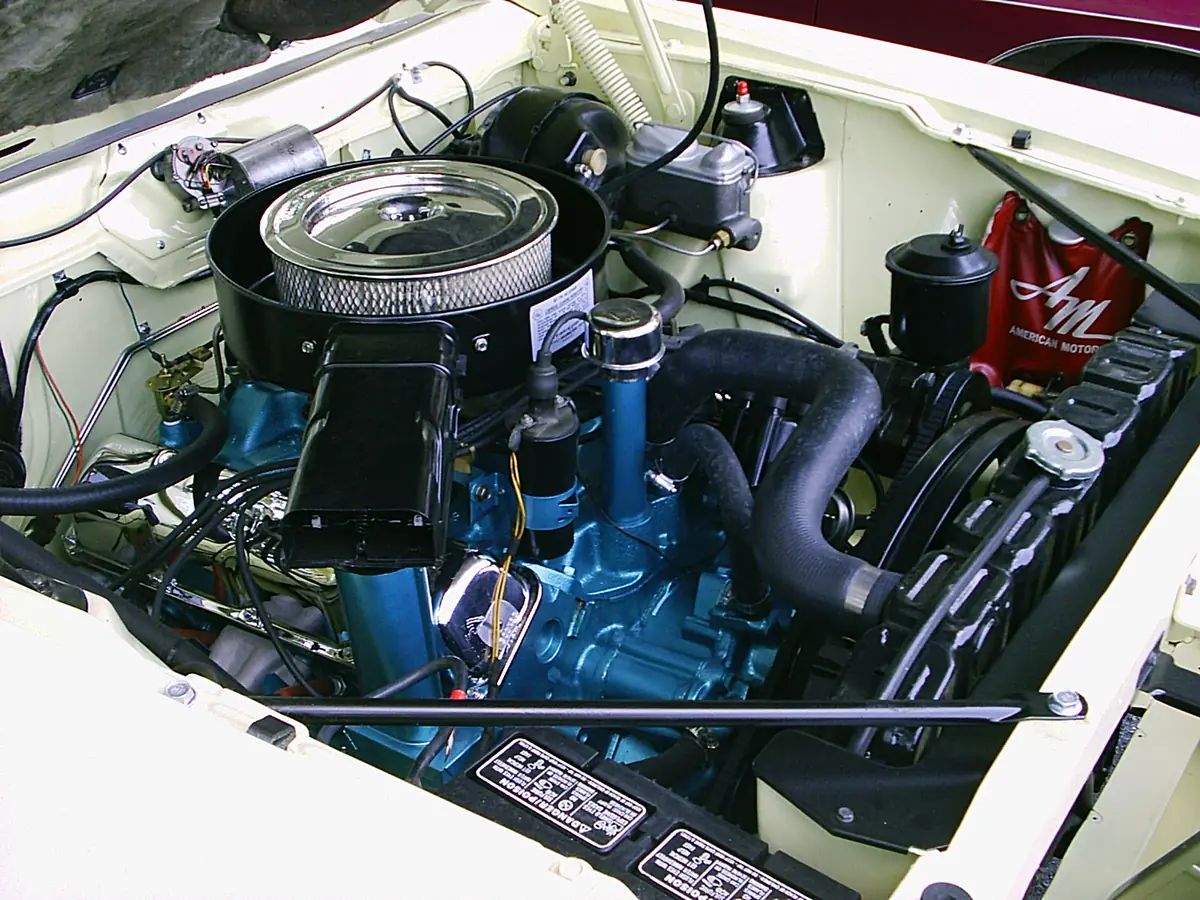

There is no military exemption. The DMV says active-duty service members and veterans still need a smog check like everyone else.
Do electric cars need a smog check in California?
Fully electric cars do not need a smog check in California, at renewal or at a sale, because they have no engine and no tailpipe. Both BAR and the DMV list electric vehicles as exempt. The exemption covers battery-electric cars only; anything with a gasoline engine on board, including a plug-in hybrid, is tested like a gas car.
Do hybrids need a smog check in California?
Hybrids and plug-in hybrids need a smog check in California on the same schedule as gasoline cars. The Smog Check Referee program puts it plainly: "Hybrids are not exempt from smog checks." A hybrid skips the renewal test only during its newest eight model years, paying the same abatement fee as any gas car.
BAR's reference guide shows hybrids have been part of the program since January 2015. They get the same on-board computer inspection as other 2000 and newer gas cars.
Are diesel trucks exempt from smog check?
Diesel vehicles in California are exempt only if they are model year 1997 or older, or rated over 14,000 lb GVWR. BAR says "there are no model year exceptions for diesel vehicles," so a 1998 or newer diesel pickup up to 14,000 lb needs a smog check every other year, even when brand new.
Heavier diesel trucks fall under a separate CARB program, not Smog Check. Our diesel smog check guide covers both.
Are collector cars exempt from smog check?
Collector cars from 1976 and newer still need a smog check in California today, but a state Referee does an abbreviated inspection: tailpipe test, gas cap test and a fuel leak check. SB 1392 (Chapter 245, Statutes of 2026) exempts qualifying collector vehicles built before the 1981 model year starting January 1, 2028.
The SB 1392 cutoff then moves up one model year each year until it covers vehicles built before 1986, from 2033. Nothing changes for an ordinary car.
To count as a collector car, BAR says the vehicle must be insured as one, used mainly for shows, parades and similar events rather than transportation, and be at least 35 model years old, or 25 with historical plates, or a special interest vehicle kept to factory spec. Kit cars and grey-market imports do not qualify. Our post on the Smog Check Referee explains how to book that inspection.
Do you need a smog check when you sell or transfer a car?
Selling a car in California triggers a smog check unless the car is one of the newest four model years. In 2026, 2023 and newer gas and hybrid cars skip the test and the buyer pays an $8 smog transfer fee. A 2022 or older car needs a pass from the last 90 days, provided by the seller.
That shorter window catches people. A 2021 car is exempt from the renewal test but not from the sale test, so its owner may be getting the car's first-ever smog check just to sell it. Our guide to buying a used car and its smog history covers who pays and what to look for on the record.
Family transfers
Transfers between immediate family members do not need a smog check. The DMV defines family as a spouse, domestic partner, sibling, child, parent, grandparent or grandchild. The exception: if a relative bought the car for you without first titling it in their own name, the DMV treats it as a sale and a smog check is required.
What if you are not exempt?
Check the model year against the table above, read your renewal notice, and get the test inside the 90 days before your registration expires. A certificate is good for 90 days and goes to the DMV electronically. Our post on when the renewal smog check is due explains the timing.
BAR does not regulate inspection prices. Stations reported an average of $69.16 in August 2026, and every station must also charge the $8.25 state certificate on a pass. The coupons in our directory set a median special price of $39.75 as of October 2026, so compare smog check coupons and stations near you before you drive over.
Sources: BAR: Smog Check · DMV: Smog inspections · DMV: Smog abatement fee bulletin · BAR: Collector cars · Smog Check Referee: Smog exemptions · SB 1392 (2026) · AB 2683 (2004) · BAR Smog Check Executive Summary, August 2026
Figures checked against BAR, DMV and CARB sources as of October 2026.