Buying a Used Car in California? Check Its Smog History
Tuesday, July 28, 2026 · Updated · Fact-checked against official sources


When you buy a used car from a private seller in California, the car must have passed a smog check within the last 90 days, and the seller provides it. Before you pay, pull its free inspection history by plate or VIN with our smog check history lookup. As of October 2026, nothing spots an emissions problem faster.
That record was written by licensed stations at the time of each test, not by the seller. Below is how the sale rules work and what to look for in the history.
Who pays for the smog check when selling a car in California?
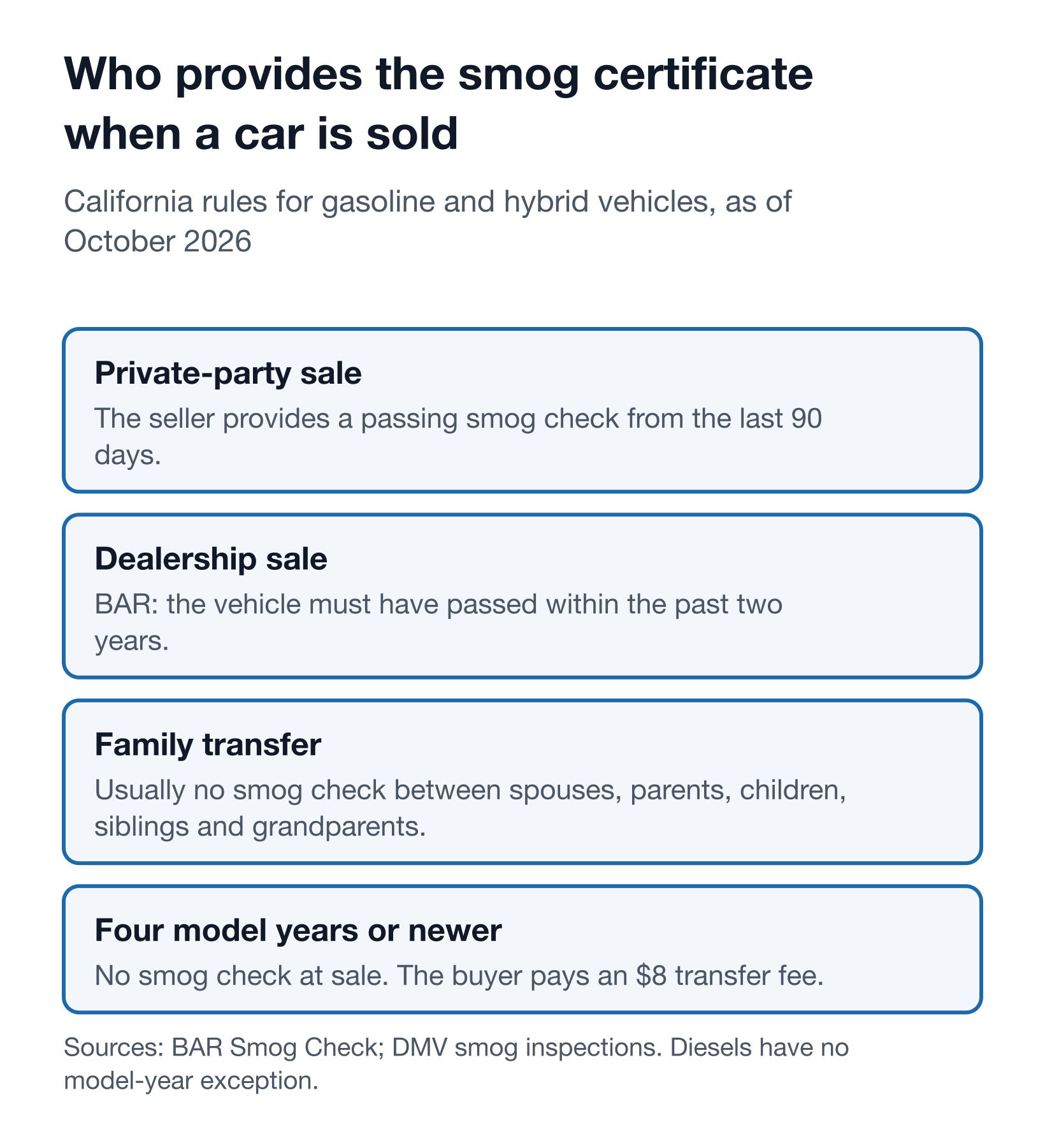
The seller pays for the smog check when a car is sold privately in California. The DMV says that if you are selling your car, "you need to give the new owner a valid smog certification." BAR adds that the inspection comes before the sale and the seller should give the buyer the vehicle inspection report.
The certificate must come from a pass within the last 90 days. A smog certificate is valid for 90 days and is sent to the DMV electronically, so an older pass does not count for the transfer, even if the car passed easily.
The inspection price is not set by the state. Stations reported an average of $69.16 in BAR's August 2026 summary, and stations must also charge the $8.25 certificate fee on a pass. Our post on what a smog check costs in California breaks that down by station type.
Does a used car from a dealership need a smog check?
A used car bought from a California dealership still needs a valid smog check, but BAR sets a different window than for private sales. BAR's consumer page says a vehicle bought from a dealership "must have passed a Smog Check within the past two years." The private-party rule is stricter: a pass within the last 90 days.
Either way, you can confirm the date yourself. The dealer's certificate shows up on the same public inspection record as every other test.
How do you check a used car's smog check history?
You can check any California car's smog check history for free with its VIN or license plate number. BAR keeps the official inspection record and updates it daily at midnight. Each entry shows the inspection date, the station and whether the car passed or failed. Our smog check history guide walks through the lookup.
BAR recommends using the VIN, because a car's plate number can change. Run the check before you negotiate. It is free and the seller does not need to know.
What should you look for in a car's smog history?
A healthy California smog history shows a pass roughly every two years once the car is past its first eight model years, with no failures or with a failure followed quickly by a pass. Patterns worth questioning are repeated failures before each pass, a gross polluter result, unexplained gaps, and a pass dated just before the listing went up.
Repeated failures
One failure followed by a pass is normal; cars fail and get fixed. A fail-then-pass pattern every cycle points to an emissions system that is barely making it. The next owner inherits that.
A gross polluter result
A gross polluter is a car whose tailpipe emissions exceeded BAR's separate, higher gross polluter limits. After that result, the car can only be certified at a STAR station or a state Referee. Price the car as if it needs real emissions work, and read what gross polluter means before you buy.
Gaps in the record
If a 2014 car shows tests in 2019 and then nothing until 2025, ask why. It may have been registered out of state, stored, or kept in a county that does not test at renewal. A car that sat for years can develop problems a short test drive will not reveal.
STAR-only certificates
A STAR station on the record means little by itself. Anyone can choose one, and BAR randomly sends a 2% sample of cars in enhanced areas to STAR stations. A STAR certificate every cycle, though, can mean BAR's statistical model has flagged the car as likely to fail. Our STAR smog check guide explains how directed vehicles work.
A brand-new pass
A pass dated a few days before the listing is often just the seller following the law. Ask whether repairs were needed to get it, and ask for the receipts.
Which used cars don't need a smog check at sale?
A used car in California does not need a smog check at sale if it is one of the newest four model years, moves between immediate family members, or is permanently exempt. For a 2026 sale, gas and hybrid cars from 2023 and newer skip the test, and the buyer pays the DMV an $8 smog transfer fee instead.
- Family transfers. A spouse, domestic partner, sibling, child, parent, grandparent or grandchild can transfer a car without a smog check, unless the relative bought it for you without first titling it in their own name.
- Permanently exempt vehicles. Gas cars from 1975 and older, diesels from 1997 and older or over 14,000 lb GVWR, electric vehicles and motorcycles.
- No diesel exception. BAR says "there are no model year exceptions for diesel vehicles," so a 1998 or newer diesel needs a smog check at sale even when it is new.
The renewal and sale windows are different. A 2021 car is exempt from the renewal test in 2026 but not from the sale test, so its owner may never have smogged it before. An empty history is normal for a car that young. Our post on which cars are exempt from smog check has the full model-year table.
What if the seller won't provide a smog check?
If a private seller in California will not provide a smog check, the seller is not meeting their legal duty, and you take on the risk of a failure. A common offer is a discount in exchange for the buyer handling the test. A discount covers a passing inspection, but it does not cover emissions repairs if the car fails.
BAR's August 2026 summary gives a sense of repair bills. Inspectors entered 3,941 repairs that averaged $783.13, and repairs done through the state's Consumer Assistance Program averaged $1,438.88. BAR notes most non-assistance repairs are never entered, so treat these as a rough guide.
A sensible order of operations:
- Pull the smog history before you talk price.
- If the record looks clean but the seller still refuses, propose testing together at a nearby station before money changes hands.
- If the record shows repeated failures or a gross polluter result and the seller avoids the test, walk away.
- Treat "it just needs a sensor" as an unpriced repair.
If you end up needing a test, find a smog check near you or browse the statewide station directory.
Does a car from out of state need a smog check?
A car registered in California for the first time needs a smog check, including cars bought in another state or previously registered elsewhere. BAR says the inspection confirms the car meets California emissions standards and that aftermarket parts meet California rules. If the car has aftermarket parts or modified engine software, sort that out before you buy.
A pass tells you the car met the standard on the day it was tested. The history tells you how it got there.
Sources: BAR: Smog Check · BAR: Check a vehicle's inspection history · DMV: Smog inspections · DMV: Registration fees · BAR Smog Check Executive Summary, August 2026
Figures checked against BAR, DMV and CARB sources as of October 2026.